
How to Search New London County Court Records
The right starting point depends on the case type. Connecticut runs a statewide court system, so there is no separate county clerk portal. The Judicial Branch lookup hub gathers the main tools in one place. Civil, family, housing, and small claims matters use the Superior Court Case Look-up. Criminal and motor vehicle matters use a separate Criminal / Motor Vehicle Case Look-up. Probate estates and trusts use the Connecticut Probate Courts system. Pick the category first, then open the matching tool.
The hub at the Connecticut Judicial Branch ties these searches together. The image below shows that page.
The official Judicial Branch case lookup hub lists every public search route by court level and case type.
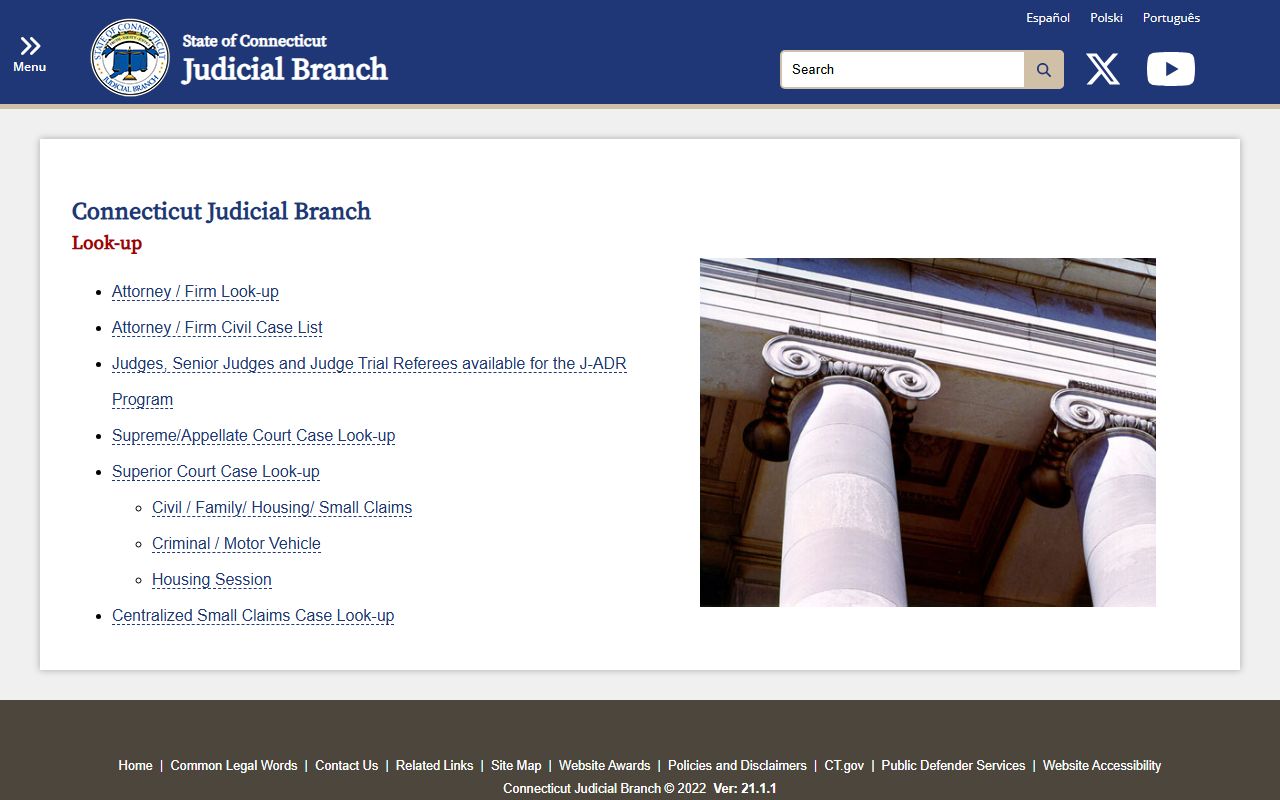
That page is the cleanest official map of where New London court records actually live, from civil inquiry to the criminal docket tools.
Before you start, gather the basics. A full name with correct spelling helps. A docket number helps more. Think in terms of court location and case type, not a county clerk window. The civil portal even lets you narrow by location to New London when the list loads.
- Open the Superior Court civil case look-up for civil, family, housing, or small claims matters.
- Enter a party last name, add a first name, then pick a name search type such as Starts With, Contains, Is Equal To, or Sounds Like.
- Narrow by location, case category, and case type so New London results rise to the top.
- Review the docket entries, parties, court events, and any listed motions or documents.
- Request a certified copy through the clerk's office if you need an official record.
The portal carries a Judicial Branch disclaimer. It calls the look-up a public service, says the branch tries to keep data current, and warns that it does not warrant accuracy or assume liability for errors, omissions, or availability.
New London Superior Court Search Fields
The civil inquiry party search uses a small set of fields. Knowing them ahead of time saves trips back to the form. The civil case look-up screen shows the menu and the public-service disclaimer up front.
The civil, family, housing, and small claims look-up handles party-name and docket-number searches for New London Superior Court matters.
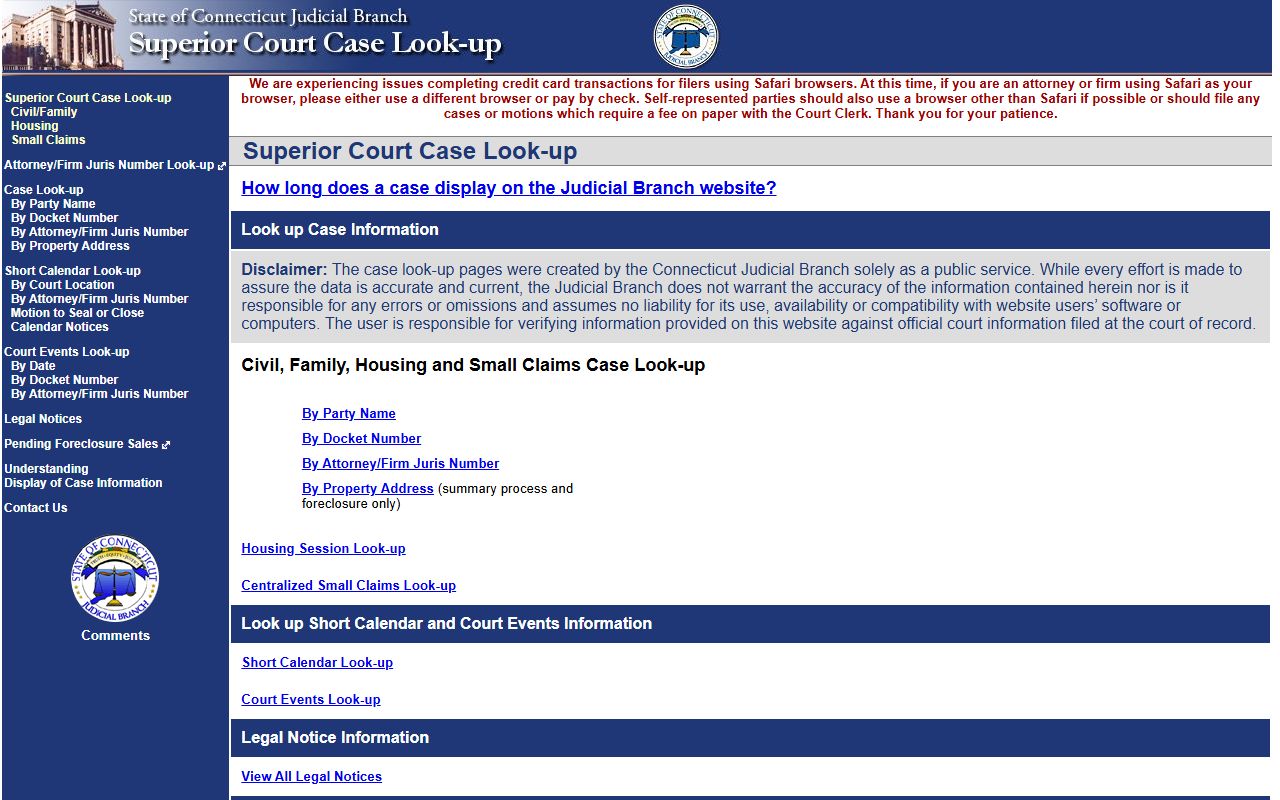
From that screen you can switch between By Party Name, By Docket Number, By Property Address, and several court-event modes.
| Field Label | Type | Notes |
|---|---|---|
| Party Last Name | Text | Main name field; search type controls matching |
| Party First Name | Text | Narrows a broad last-name search |
| Location | Dropdown | Default All; choose New London when loaded |
| Case Category | Dropdown | Default All; filters by category |
| Case Type | Dropdown | Default All; filters by case type |
| Name Search Type | Radio | Starts With, Contains, Is Equal To, Sounds Like |
Use Is Equal To when the spelling is exact. Use Contains or Sounds Like when the spelling is in doubt. A full picture of these tools sits on the court records and court dockets pages.
The New London County Judicial System
Connecticut runs one statewide trial court of general jurisdiction, the Superior Court. New London is one of the state's 13 judicial districts. There is no locally elected county court here. Civil, criminal, family, housing, juvenile, small claims, and motor vehicle matters all fall under the Superior Court, then split among judicial district locations and Geographical Areas.
Above the Superior Court sit two appellate levels. The Connecticut Appellate Court reviews trial-court judgments. The Connecticut Supreme Court is the final word on state law. Below the judicial district level, Geographical Area sessions handle other felonies, misdemeanors, and many motor vehicle matters. Major felonies route to the judicial district courthouse. Probate is not part of the Superior Court at all.
Case flow: Geographical Area / Superior Court › Connecticut Appellate Court › Connecticut Supreme Court
| Court | Jurisdiction | Case Types |
|---|---|---|
| Connecticut Supreme Court | Highest state court | Final appeals, selected direct matters |
| Connecticut Appellate Court | Intermediate appeals | Appeals from Superior Court, some agency matters |
| Connecticut Superior Court | General trial court | Civil, criminal, family, housing, juvenile, small claims, motor vehicle |
| Connecticut Probate Courts | Separate probate trial courts | Estates, trusts, conservatorships, guardianships, name changes |
| Geographical Area sessions | Superior Court locations | Other felonies, misdemeanors, motor vehicle matters |
Full detail on the trial court sits on the New London County Superior Court page. The Judicial Branch fast facts list 13 judicial districts, 20 Geographical Areas, and 12 juvenile districts statewide.
Superior Court vs Geographical Area
People often mix up these two Superior Court tracks. The difference decides which courthouse to visit and which clerk to call. Major felonies and civil suits run through the judicial district courthouse. Many lower-level criminal and motor vehicle matters run through a Geographical Area session. Both are parts of the same statewide Superior Court, not separate county courts.
| Feature | Judicial District | Geographical Area |
|---|---|---|
| Role | Major felonies and civil matters | Other felonies, misdemeanors, motor vehicle |
| New London site | 70 Huntington Street, New London | 112 Broad Street, New London (GA 10) |
| Norwich track | Family clerk at 1 Courthouse Square | GA 21 at Norwich for assigned towns |
| Where to search | Civil case look-up | Criminal / Motor Vehicle look-up |
Use the docket or notice, not just the arrest town, to find the correct courthouse. Criminal matters are covered in more depth on the arrest records page, and tickets on the traffic court records page.
New London Criminal and Motor Vehicle Records
Criminal and motor vehicle matters use a separate look-up from the civil portal. The Judicial Branch splits these searches into Convictions, Daily Docket, Pending Case, Attorney/Firm look-up, Arrest Warrants, Sentence Review, and Motions to Seal or Close. A single search does not return a full criminal history.
The landing page also carries a key public-record notice. The Criminal / Motor Vehicle Case Look-up page links each of these tools.
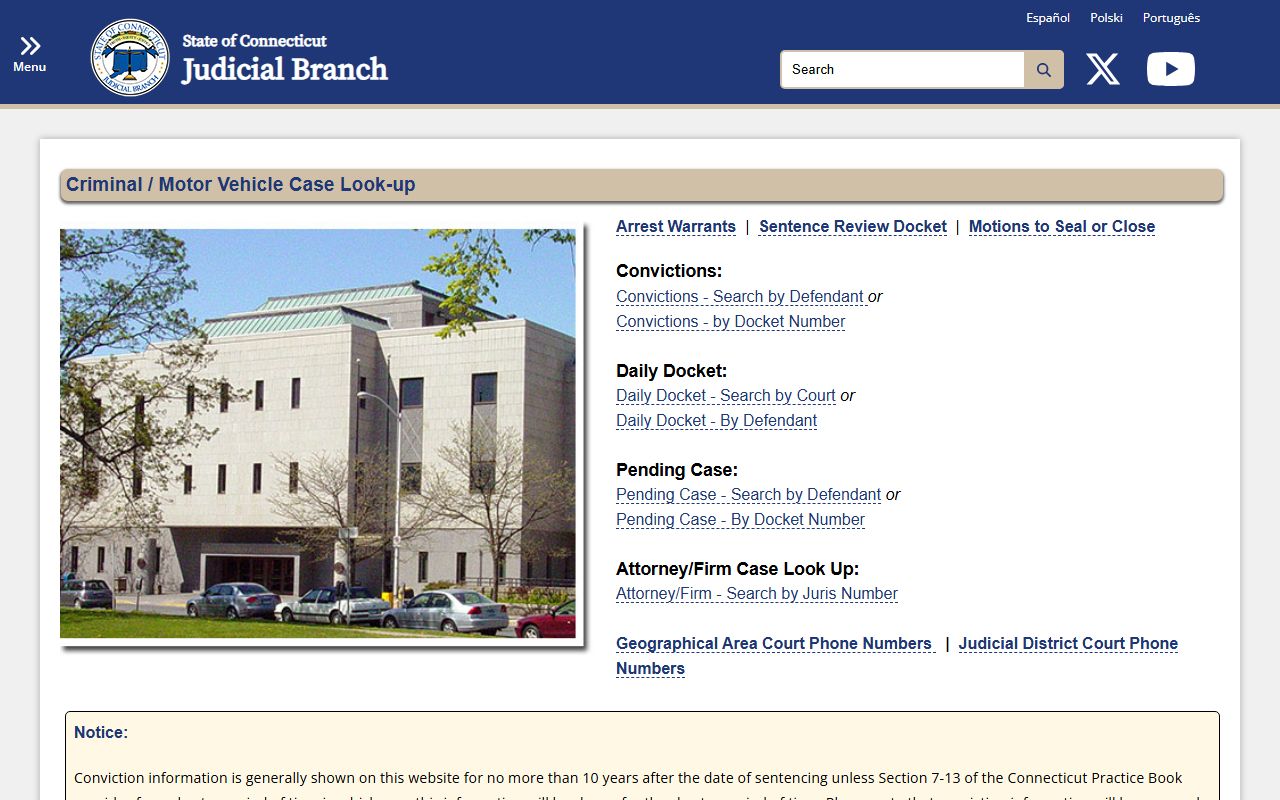
That notice says conviction information is generally shown for no more than 10 years after sentencing unless Practice Book section 7-13 sets a shorter period.
Youthful Offender cases, juvenile cases, and infraction or violation convictions are not shown. The branch also warns that criminal history can change daily because records may be erased, corrected, pardoned, or otherwise modified. A pending arrest may need the Pending Case search, while an old conviction may need the Convictions search.
Types of Court Records Available in New London County
New London County court records cover a wide span of case types. Each type is produced by a different division and follows different access rules. Civil and family files come from the Superior Court. Criminal and motor vehicle matters use the criminal look-up. Probate files run through separate Probate Courts. Traffic infractions route through a centralized bureau. Knowing the type tells you both the portal and the office.
Here are the main categories you can look up.
- Criminal records - docket number, charges, court location, and conviction status within display limits.
- Civil records - complaints, motions, judgments, foreclosure, and small claims activity.
- Family and divorce records - dissolution, custody, and support, some restricted to parties.
- Probate records - estates, trusts, and conservatorships through the Probate Court.
- Traffic records - payable infractions through the Centralized Infractions Bureau.
Juvenile matters sit apart from all of these. Connecticut General Statutes section 46b-124 makes juvenile records confidential, so they do not appear in the public criminal look-up.
What New London County Court Records Show
A court record is built from many small fields. The Superior Court docket lookup can show the docket number, case name, location, category, parties, court events, and listed motions or documents where public. The full image of a filed document is often not available online. For that, you request a copy from the clerk.
| Field | What It Shows |
|---|---|
| Case Number | Docket number built from location, category, year, and number |
| Filing Date | When the case opened at the court location |
| Parties | Plaintiff, defendant, petitioner, or respondent names where public |
| Charges / Cause | Charge text in a criminal case or the cause in a civil case |
| Disposition | How a charge, claim, or case was resolved |
| Sentence / Judgment | The final order, judgment, or sentence entered |
Some fields are withheld. Social Security numbers, financial account data, minor names, sealed matters, and juvenile details may be redacted or not displayed at all.
Public Access Laws for New London County Court Records
Connecticut uses two separate access systems, and mixing them up is the most common mistake. Agency records, such as town clerk and police files, fall under the Connecticut Freedom of Information Act in Chapter 14 of the General Statutes. Court case records do not run on that track. Court files are governed by Judicial Branch rules, the Practice Book, and statutes on sealing, erasure, and juvenile confidentiality. So do not file an FOI request for a divorce judgment, and do not expect the town clerk to hold a Superior Court file.
Criminal record display is dynamic. Erasure, pardons, and corrections can change what appears online from day to day.
Key Statutes:
C.G.S. § 1-210 - records kept by a public agency are public unless a statute or federal law says otherwise, with listed exemptions.
C.G.S. § 1-212 - sets copy and fee mechanics for many agency records, though court clerk fees are checked separately.
C.G.S. § 54-142a - criminal record erasure that can treat an eligible matter as if the arrest never happened.
C.G.S. § 46b-124 - makes juvenile matter records confidential with narrow access exceptions.
Records That Are Restricted or Confidential
Not every court record is open. Several statutes and Practice Book rules wall off sensitive material. Juvenile delinquency files are confidential under C.G.S. section 46b-124. Youthful Offender cases are not displayed. Erased criminal matters drop out of public search results under the erasure and Clean Slate rules. Sealed files require a judicial finding before access is limited. Adoption, mental health commitment, and many family records involving minors are restricted as well.
Sealed and erased are not the same. Sealing limits access by court order while the record may still exist. Erasure can treat the matter as if the arrest never occurred for many public purposes. A petition to view a sealed file uses the court's motion process, cites the governing Practice Book rule or statute, and shows the required privacy or safety interest. When a search turns up nothing, that is not proof a record never existed. The case may be sealed, erased, restricted, misspelled, or simply not indexed online.
New London County Probate Court Records
Probate in New London County runs through separate Connecticut Probate Courts, not the Superior Court clerk. Several districts serve the historical county, including Norwich, Southeastern Connecticut Regional, New London, Niantic Regional, and the New London Regional Children's Probate Court. These courts handle estates, trusts, conservatorships, guardianships, name changes, and children's matters.
The Probate Court Case Lookup covers decedent estate and trust data from January 5, 2011 forward. The Probate Court Case Lookup lets you filter by case type, district, status, first name, and last name.
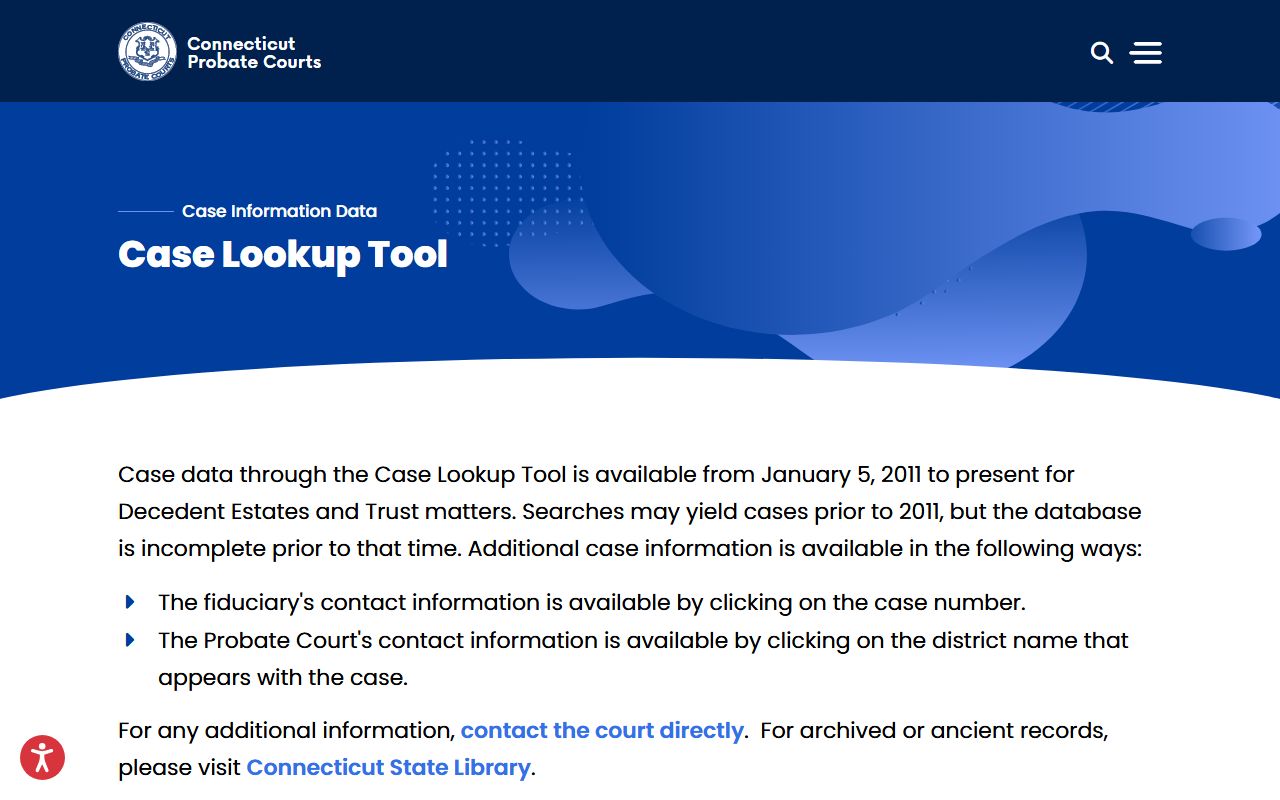
Clicking a case number can show fiduciary contact details, and clicking the district name can show court contact information.
To find the right court, start with the town tied to the matter. The Probate Court locator maps each district to its towns, judge, and chief clerk.
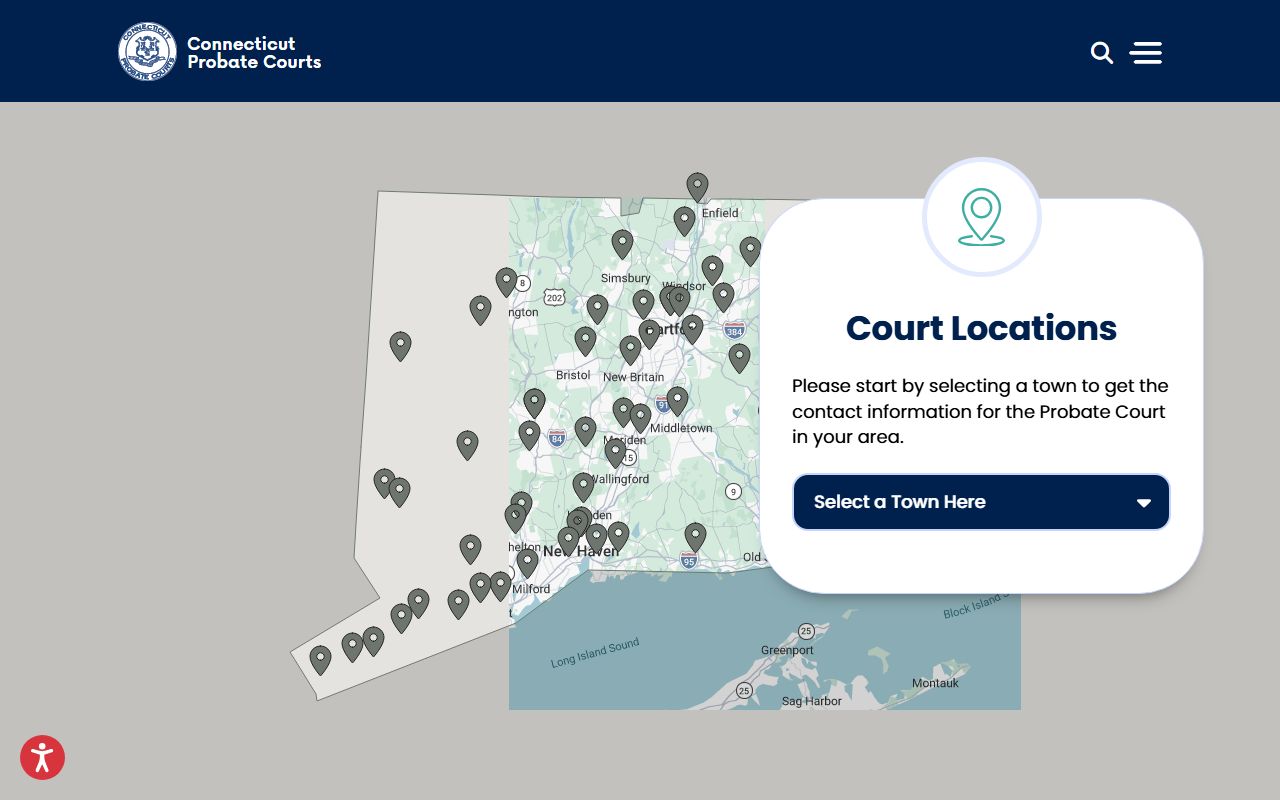
That locator confirms, for example, that New London Probate Court serves New London and Waterford, while Norwich Probate Court serves Norwich and several northern towns. Full detail sits on the probate records page.
New London County Sheriff and Jail
There is no elected county sheriff running a New London County jail roster. Connecticut unified its county jails and state prisons under one Department of Correction in 1968. Courthouse security is handled by Judicial Marshals, and arrests are made by municipal or state police. For inmate research, the official path is the statewide DOC inmate search.
The DOC search covers everyone in state custody, both pretrial and sentenced. The Connecticut DOC inmate search uses a DOC number, name, or date of birth.
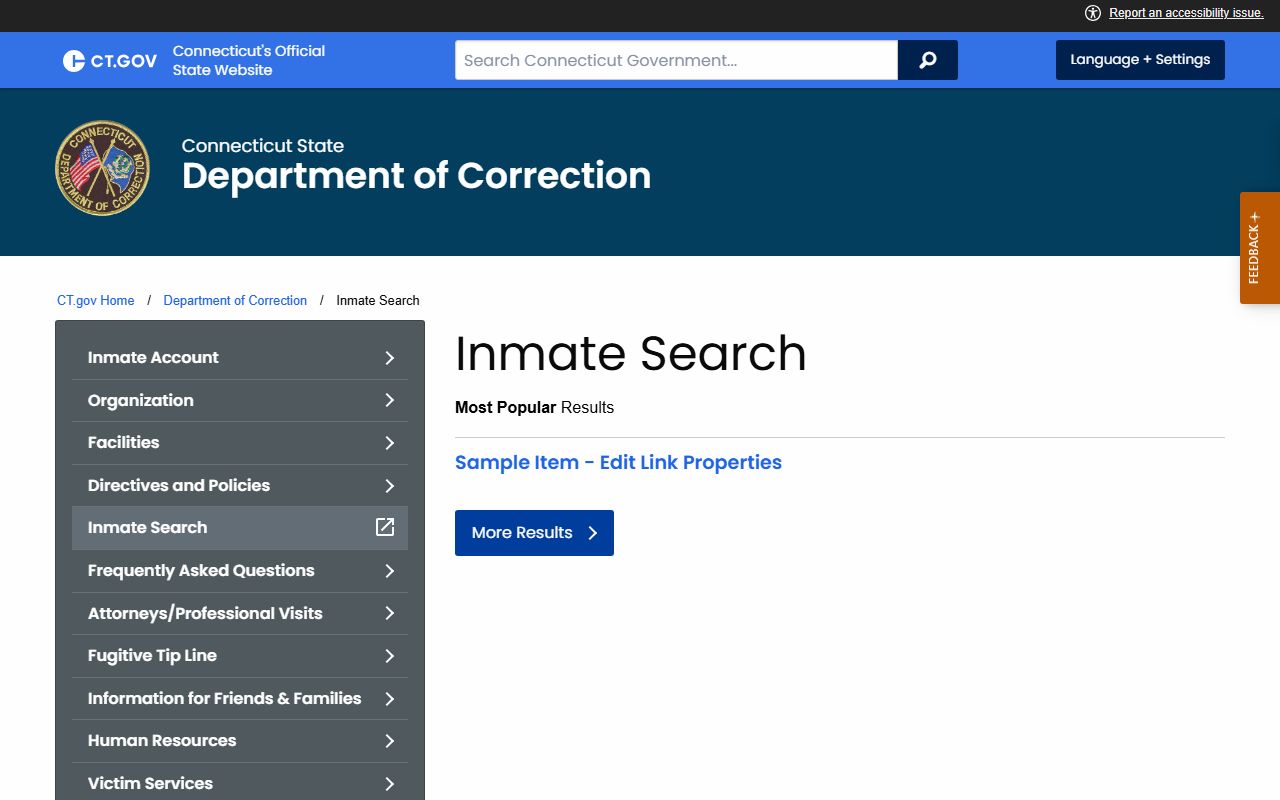
Two state facilities sit physically in the county. Corrigan Correctional Center in Uncasville serves Superior Courts in Danielson, New London, Norwich, and Windham. York Correctional Institution in Niantic is the state's only women's correctional institution.
For the full roster picture see New London County inmate records, and for active warrants see the warrant records page. Release verification is covered on the released inmates page.
Specialty Courts in New London County
New London criminal justice programs run mostly through statewide Judicial Branch and Division of Criminal Justice systems rather than locally created courts. The New London State's Attorney oversees staff at the judicial district courthouse, the Geographical Area courts, and Juvenile Matters in Waterford. Specialty access is framed as New London Judicial District access to Connecticut programs.
Adult probation and pretrial services are central to diversion and supervision. The Judicial Branch directory lists adult probation supervision offices in New London and Norwich and pretrial bail services tied to 112 Broad Street. Family Services supports custody studies, dispute resolution, and court referrals across the district. Victim services run through advocates assigned by courthouse, and Connecticut SAVIN provides court status updates by phone or email.
Marriage, Divorce, and Probate Court
Marriage licenses come from the vital records office or town clerk in the town where the marriage will take place, not the courts. Divorce is a Superior Court family matter, and the State Vital Records Office does not hold divorce decrees. Probate runs through the separate Probate Courts. See marriage and divorce records and the probate records page for the full process.
- Testator
- The person who made a will.
- Executor
- The person named in a will to settle the estate.
- Conservator
- A probate-appointed person who manages the affairs of an incapacitated adult.
New London County Court Records Fees
Fees depend on the office and the record. Vital records carry per-copy fees set by the state. The marriage license has its own fee. Probate eFiling adds a small service charge per transaction. A Superior Court copy or certification fee was not located in official sources during research, so confirm that with the clerk before you order. The table below lists documented fees from official Connecticut pages.
| Item | Amount |
|---|---|
| Town birth, death, marriage, or civil union certificate | $20 per copy |
| State birth certificate | $30 per copy |
| Connecticut marriage license | $50 |
| DMV certified driving history | $20 |
| Probate eCheck service fee | $1.00 per eCheck |
Note: Vital record fees are paid to the town or state, while court copy fees are handled separately through the clerk's office.
How to Interpret New London County Court Records
Reading a docket takes a little practice. The docket number is the key. A Connecticut civil docket number builds from location, category, year, and number, so its exact form matters when you call or order copies. Status can read as pending, disposed, closed, open, sealed, or erased, and one part of a case can change without ending the whole matter.
Charges are not the same as convictions. A criminal search may show a charge that was later dismissed, nolled, or never proven. A nolle is a prosecutor's decision not to pursue a charge at that time. Conviction data shows only within the display period, so a missing result does not prove a clean record. When a docket lists a document but shows no image, the file still exists; you request the copy from the clerk.
Accuracy and Record Limitations
Online systems lag real events. An erasure, a correction, a pardon, or a new filing may take time to show up in the public look-up. The Judicial Branch states plainly that criminal history information can change daily. Public portals are also not full background checks. Employment, licensing, immigration, and firearm questions often need an official criminal history or a court-certified record, not a name search screenshot.
Note: Confirm any detail that affects custody, travel, or legal rights with the office that holds the record before you rely on an online result.
History of New London County Courts
New London County holds one of Connecticut's oldest legal landmarks. The Judicial Branch courthouse history page says the New London County Courthouse was designed by Isaac Fitch of Lebanon and built in 1784 to replace a courthouse burned by the British during the American Revolution. It first served as both town hall and courthouse, with a cupola, a Palladian window, and fluted pilasters. The building was moved back from the head of State Street to its present Huntington Street location in 1839.
The same official history says Patrick Henry argued cases there and that Daniel Webster, the Marquis de Lafayette, and Horace Greeley spoke in the building. The Judicial Branch fast facts page identifies the New London Judicial District Courthouse as the oldest courthouse in Connecticut. The historic name "New London County Courthouse" lives on in old materials, while the current operating name is the New London Judicial District Courthouse.
Self-Help and Legal Aid Resources
Self-represented people have several official options in New London. The Judicial Branch Court Service Centers sit in Superior Courthouses and offer forms, public computers, printers, e-filing help, copiers, and notary services. The New London Superior Court Public Information Desk provides calendar and docket information, court forms, language assistance, and staff help. Court staff give procedural information, not legal advice.
For legal advice or representation, Connecticut Legal Services runs a get-help page and a statewide legal aid hotline. The Connecticut Legal Services portal can determine qualification and connect eligible callers with legal aid lawyers. The Judicial Branch also posts self-help guides and law-library resources for divorce, small claims, housing, and family cases. Criminal defendants who cannot afford counsel can ask about the public defender's office.
Paying a New London Traffic Ticket
Payable infractions do not run through the criminal court look-up. They use the Centralized Infractions Bureau instead. The CIB portal lets you pay or plead not guilty with the complaint ticket number from the citation.
A new ticket can take time to appear. The Centralized Infractions Bureau e-pay portal says police data can take 7 to 30 days to enter.
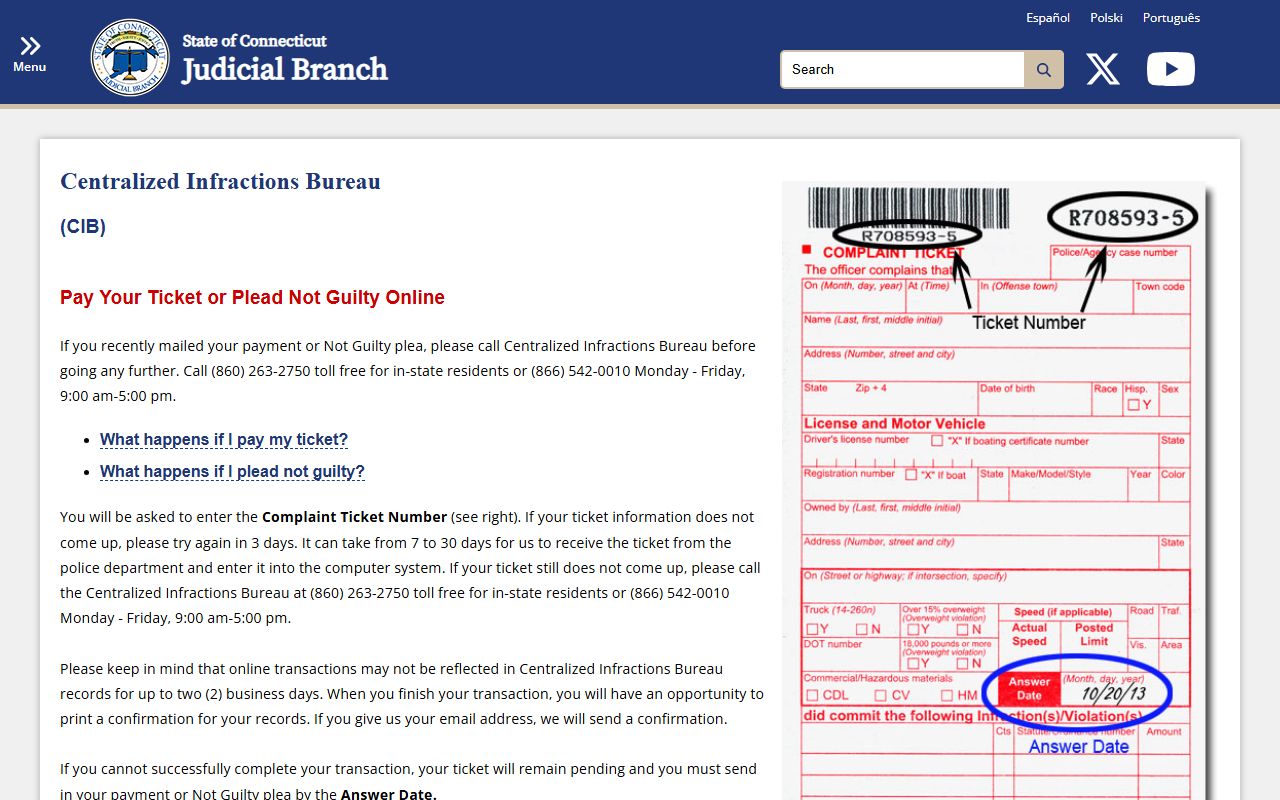
If a recent ticket does not appear, the branch says to try again in three days. A failed online transaction leaves the ticket pending, so the answer date still controls. Full detail on tickets and the DMV driving record sits on the traffic court records page.
Federal Court Records for New London County
New London County falls within the U.S. District Court for the District of Connecticut. There is no federal courthouse in the county itself. The district lists offices in New Haven, Hartford, and Bridgeport. Federal case dockets are searched through PACER, separate from any state court tool.
Federal matters follow their own rules and fees. The U.S. District Court for the District of Connecticut handles federal civil and criminal cases that arise in New London County.
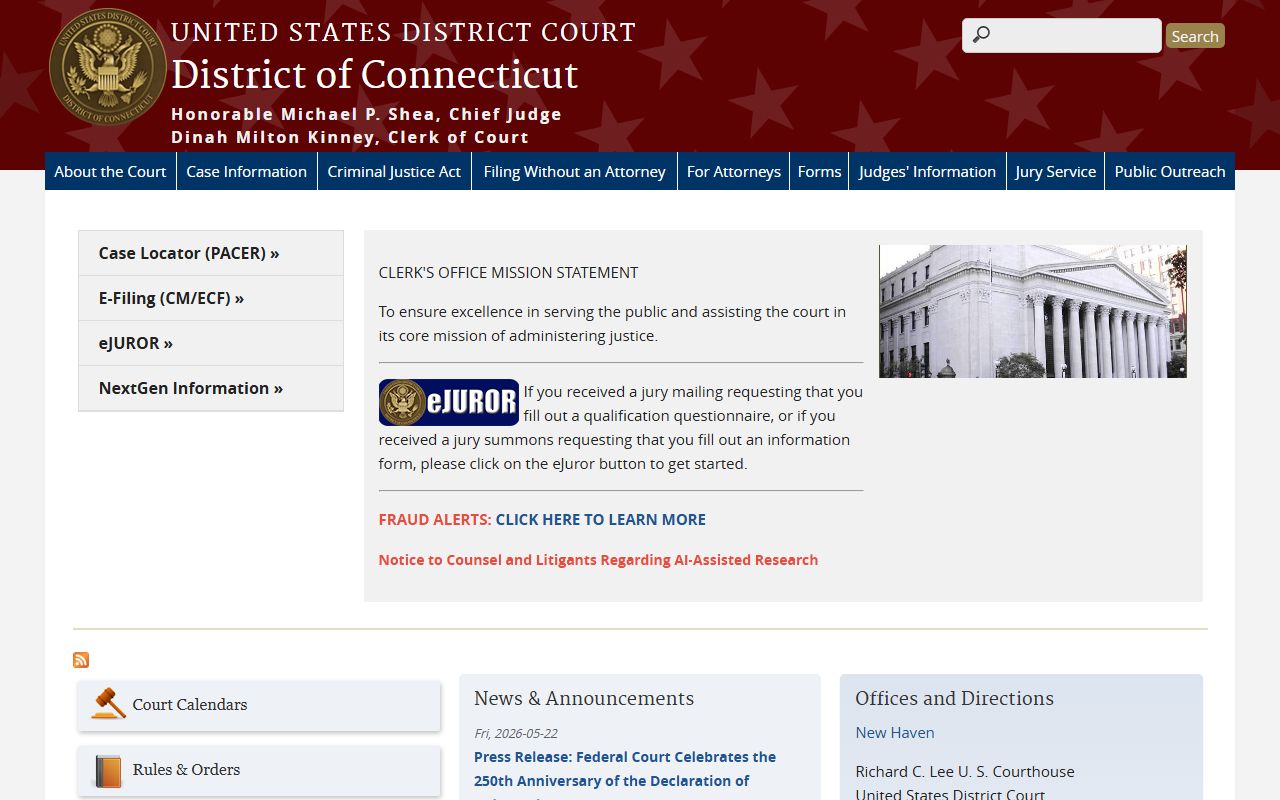
Federal inmate custody uses the Bureau of Prisons locator, not the Connecticut DOC search, and appeals from the district go to the U.S. Court of Appeals for the Second Circuit.
Frequently Asked Questions
How do I search New London County court records online?
Start at the Connecticut Judicial Branch lookup hub. Choose Superior Court civil, family, housing, or small claims for most civil and family cases. Choose Criminal / Motor Vehicle for criminal cases and motor vehicle crimes. Choose Probate Court Case Lookup for estates and trusts. New London is a judicial district in a statewide system, so there is no separate county clerk portal. If the case is old, sealed, erased, juvenile, or not indexed, the next step is a direct clerk or probate court request. More sits on the court records page.
Is there a New London County clerk of court?
Not in the county-government sense used in many states. Superior Court clerk offices are state Judicial Branch offices. Town clerks handle vital and land records, and Probate Court clerks handle probate cases. A docket copy goes to the Superior Court. A marriage certificate usually goes to the town of the event or the State Vital Records Office. A probate file goes to the right Probate Court district. The split is covered on the clerk of court and town clerk pages.
Is there a New London County jail roster?
No official county jail roster exists because Connecticut unified county jails and state prisons under the Department of Correction. Use the Connecticut DOC inmate search and the facility pages for Corrigan Correctional Center and York Correctional Institution. Corrigan serves courts in Danielson, New London, Norwich, and Windham. York in Niantic is the statewide women's institution. The absence of a county roster is a structural Connecticut issue, not a missing local page. See the inmate records page for the full lookup.
More answers sit on the New London County Court Records FAQ page.