
What Is a Court Docket in New London County
A docket is the court's official list of what happened in a case and when. Each line is a dated entry for an event: a filing, a motion, a hearing, an order, a plea, a continuance, or a judgment. Read top to bottom, a New London County court docket tells the story of a case from start to finish. It does not hold the full text of those papers. It holds the index of them. For the actual content of a motion or order, you need the underlying document, which may sit in the clerk's file rather than online.
Connecticut uses two docket ideas, and people mix them up. A case docket is the event history for one matter, tied to a single docket number. A daily docket is the court calendar for one day at one location, listing the cases set to be heard. The daily docket is most common on the criminal and motor vehicle side, where defendants need to know when and where to appear. Both are public for most case types, and both run through the Judicial Branch rather than a county clerk.
How to Find New London County Dockets Online
Start at the Connecticut Judicial Branch lookup hub and pick the track that fits your case. Civil and family dockets come from the Superior Court Case Look-up, where you can search by party name or docket number and add the Include Motions/Pleadings/Documents option. Criminal and motor vehicle dockets come from the Criminal / Motor Vehicle Case Look-up, which splits into daily docket, pending case, and conviction tools. The daily criminal docket by court is one of the most useful pages for tracking a court date.
- Open the daily criminal and motor vehicle docket by court and accept the disclaimer.
- Pick the court location, such as a New London or Norwich Geographical Area session, and the date you want.
- For a single case, switch to the pending-case tools and search by defendant name or by docket number instead of the daily calendar.
- Review the docket entries. Note the court location, the event type, and any next date, then confirm with the clerk if the matter affects an appearance.
The screen below is the official daily docket lookup by court.
The daily criminal and motor vehicle docket by court page lists New London County court dockets for a chosen courthouse and date.
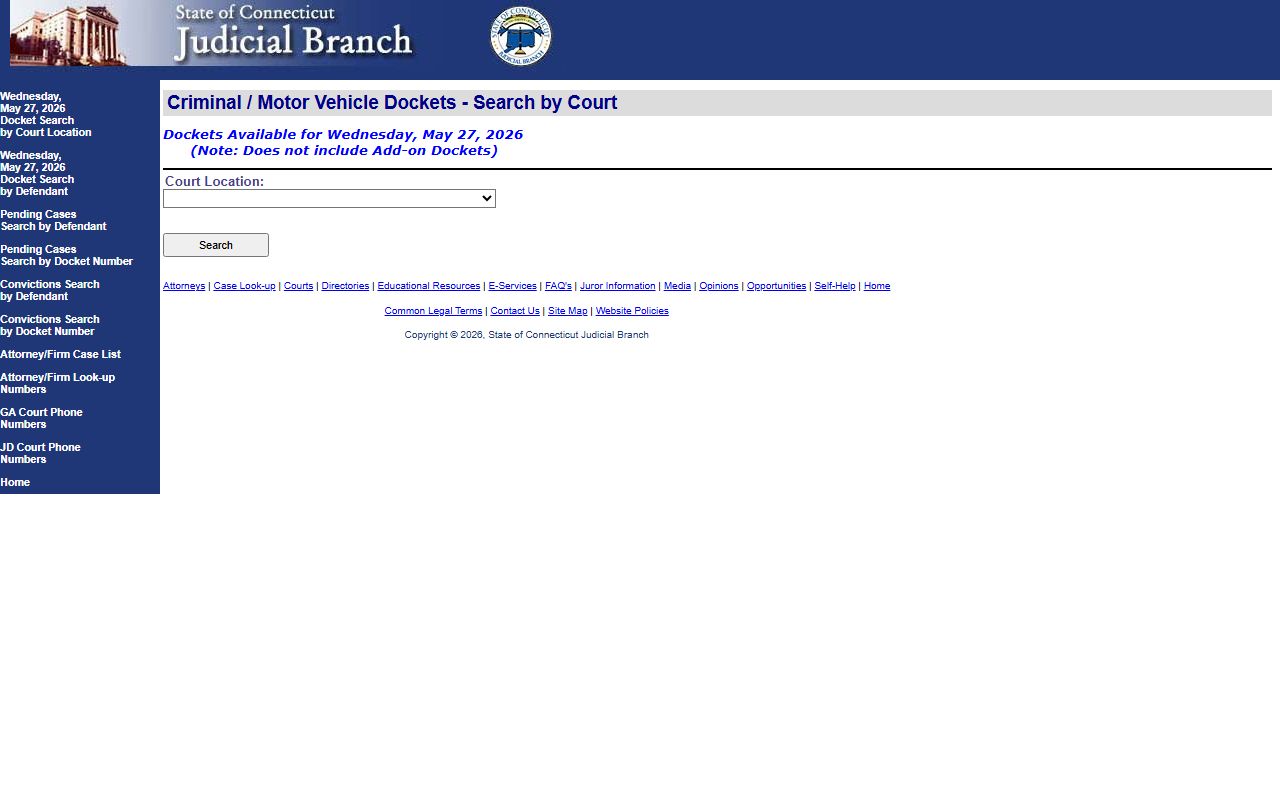
The daily docket is the quickest way to see which New London County cases are set for a given day at a given court.
Searching Pending New London County Dockets
For a case already on the calendar, the pending-case tools are more precise than the daily list. The Judicial Branch offers two routes. You can search pending criminal and motor vehicle matters by docket number, or by defendant. The defendant search asks for the full name and lets you narrow with a first-name initial, a birth year, a birth-year range, the court, and the case type. The Judicial Branch warns that criminal data may change daily because of erasures, corrections, pardons, and other modifications, so a result you see today may shift.
The lookup screen below takes a docket number directly.
The pending criminal case by docket number tool returns the docket for one New London County matter when you know its number.
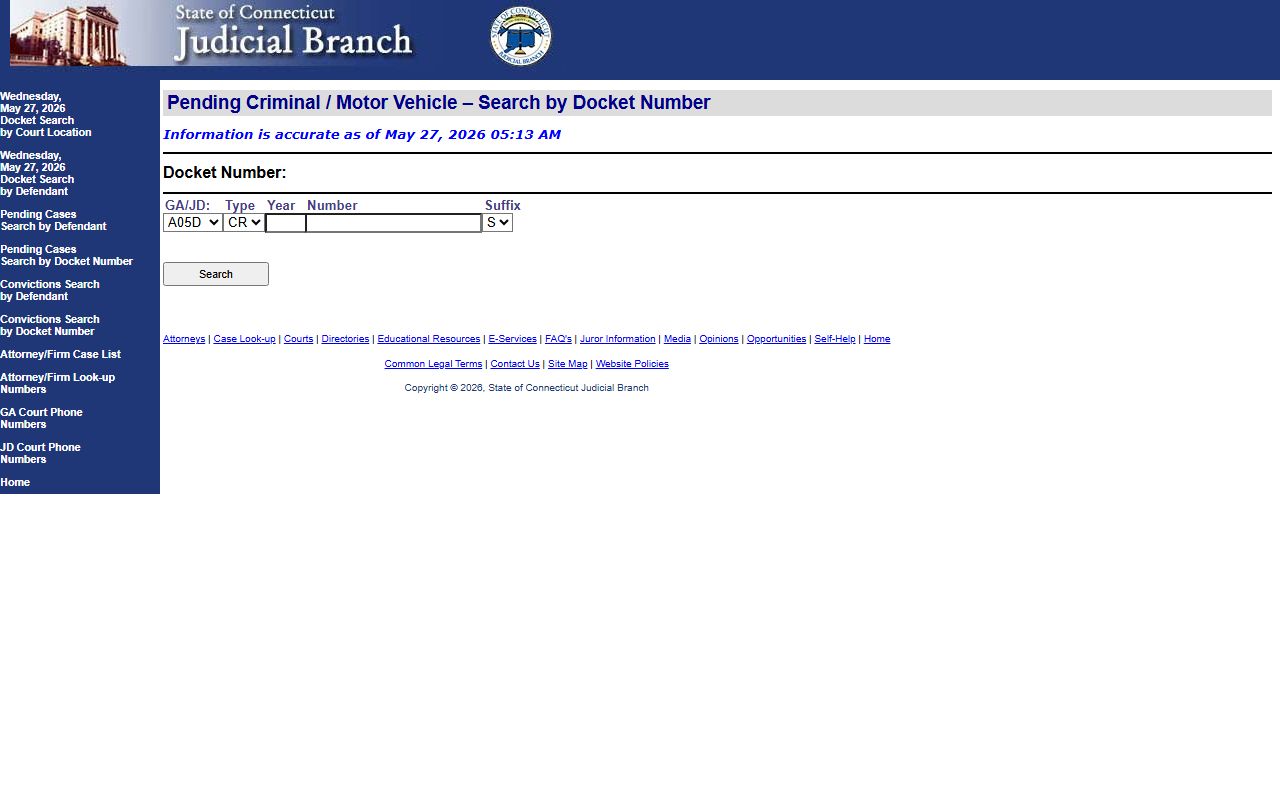
When you do not have the docket number, the defendant search fills the gap and pulls the same pending docket data by name.
The pending criminal case by defendant tool searches New London County court dockets by name, initial, birth year, court, and case type.
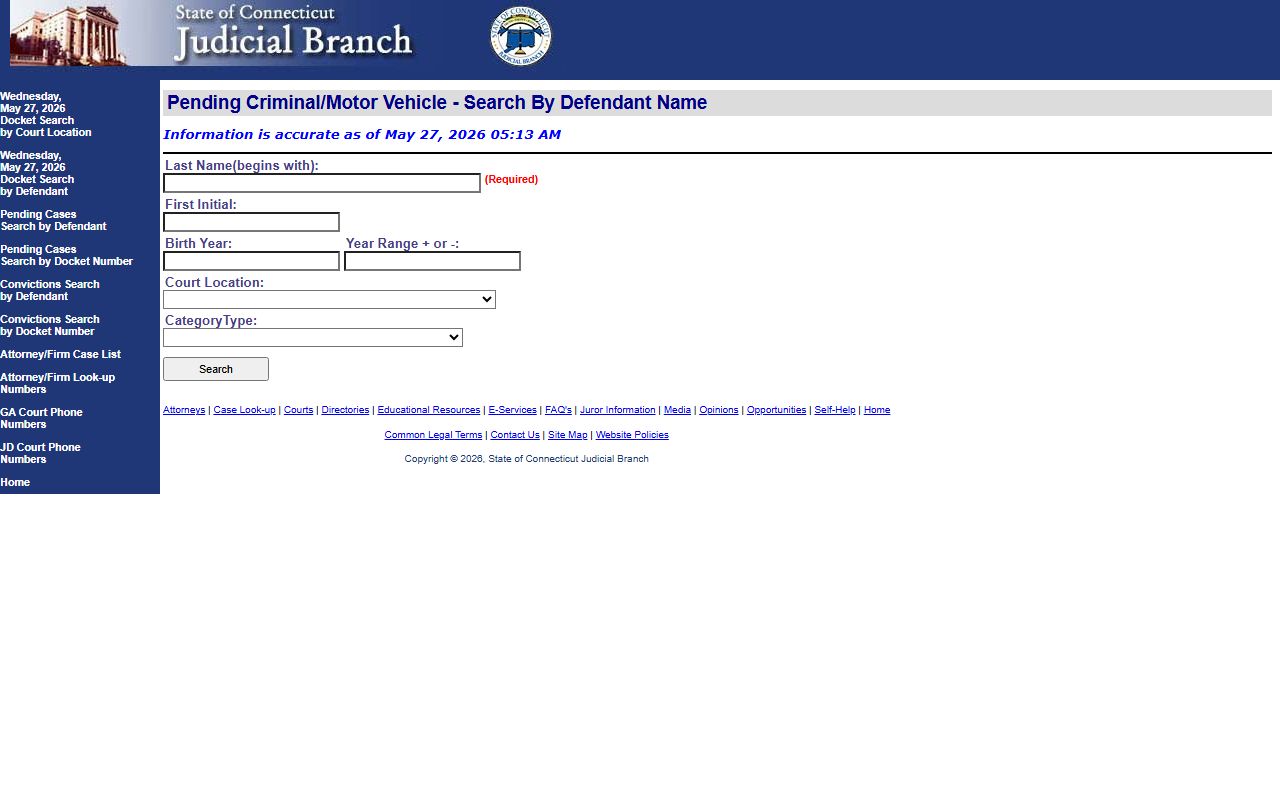
Both tools cover only pending matters, so a closed or erased case will not appear there even when it once existed.
Sample New London County Docket Entry
Each docket entry follows a simple shape. It carries a date, an event type, the party or court that acted, and a pointer to a document where one exists. Civil dockets show motions, orders, and short-calendar activity. Criminal dockets show charges, pleas, continuances, and disposition. The table breaks down the parts of a typical entry so the lines read clearly.
| Field | What It Shows |
|---|---|
| Entry Date | The date the event was recorded, which sets the order of the docket. |
| Event Type | The action taken, such as a motion, order, hearing, plea, continuance, or judgment. |
| Party Filing | The party or court that filed or entered the event, shown where the information is public. |
| Court Location | The Superior Court site or Geographical Area session handling the matter. |
| Document Link | A pointer to a motion, pleading, or order; full images are not always public online. |
| Next Date | The next scheduled event, such as a short calendar or court date, when one is set. |
Note: Sealed, juvenile, and certain family details may not display on a docket even when other entries in the same case are public.
Courts That Publish Dockets in New London County
Connecticut runs a unified court system, so docket publishing follows the case track rather than a county line. The fast facts confirm the scale of it: the Judicial Branch lists 13 Judicial Districts, 20 Geographical Areas, and 12 Juvenile Districts statewide, with New London as one of the 13 districts. Major felonies are processed at the Judicial District location, while many other felonies and misdemeanors are processed at the Geographical Area sessions. Motor vehicle cases may sit at a Geographical Area, a Judicial District, or the Centralized Infractions Bureau, depending on severity. The list below shows which courts publish dockets online for New London County.
- Superior Court, civil and family - dockets through the civil inquiry portal for civil, family, housing, and small claims matters.
- Geographical Area criminal sessions - daily and pending criminal and motor vehicle dockets through the criminal lookup tools.
- Probate Courts - estate and trust case data through the separate Probate Court Case Lookup from January 5, 2011 forward.
- Juvenile Matters - generally confidential by statute and not published in the open public dockets.
The Judicial Branch fast facts page is the official source for those district, area, and juvenile counts.
The Connecticut Judicial Branch fast facts page lists the court levels, judicial districts, and geographical areas that publish New London County court dockets.
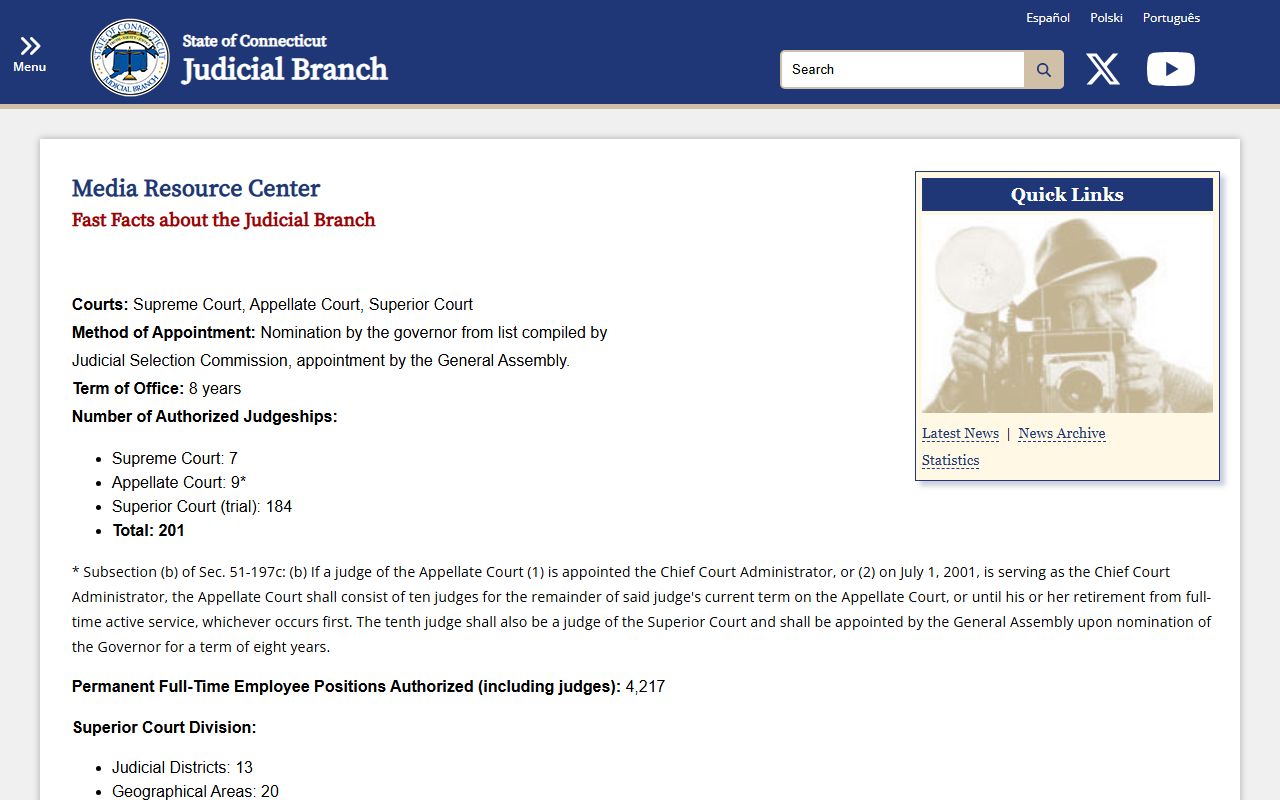
That page also notes the oldest courthouse in the state, which is the historic New London Judicial District building where many local dockets are heard.
Docket vs. Full Case Record
The docket and the full case record are not the same thing. The docket is the index of events. The full record is the stack of papers behind those events: the motions, the exhibits, the signed orders, and the judgment. Online tools usually show the docket for free, while the full documents may need a clerk request, a fee, or a visit. The comparison below sets out the difference.
| Docket | Full Case Record | |
|---|---|---|
| Format | List of dated entries | Full filed documents and exhibits |
| Access | Often online and free | May require a fee or a courthouse visit |
| Content | Event names and dates | The actual text of motions, orders, and judgments |
| Use | Track case progress and next dates | Legal review and evidence |
For the full file rather than the event list, the New London County court records page covers how to pull a complete case and when a clerk request is needed.
How to Read a New London County Docket
Docket entries lean on short labels and legal shorthand. A few terms come up again and again. An appearance is a filing that identifies a party or attorney in the case. A motion is a written request for the judge to act. A continuance is a postponement of a hearing. A short calendar is the Connecticut process for hearing civil and family motions. On the criminal side, an arraignment is the first appearance where charges and rights are addressed, and a plea is the defendant's formal response.
Outcome labels carry weight. A disposition is the result of a case or charge. A judgment is the final ruling. A nolle, short for nolle prosequi, is the prosecutor's decision not to pursue a charge for now. A capias is an order to take a person into custody, often after a failure to appear. Erasure means an eligible record has been removed from public access, which is why a case can vanish from the lookup. Charges are not convictions, and a pending docket entry only shows where a case stands, not how it ended.
Note: Because erasure and corrections update criminal data daily, confirm any docket detail with the clerk before relying on it for a court date or legal decision.