
Active Warrants in New London County
Warrants in New London County are issued by a judge or judicial authority of the Superior Court. There is no county sheriff and no county warrant office in Connecticut. The warrant system is statewide. Police and prosecutors apply for warrants, a court approves them, and the order then becomes active for service. The Judicial Branch maintains a public lookup for certain outstanding warrants, mainly violation of probation and failure to appear matters tied to court cases.
The central electronic system behind warrants is PRAWN, the Paperless Arrest Warrant Network. It is operated and maintained by the Division of Superior Court Operations within the Judicial Branch. PRAWN started in 2002, after Public Act 00-209 authorized entry of failure to appear warrants into a central computer system. It later expanded to other court warrants and arrest orders. The public search is a narrower window into that system, not full law enforcement access.
Public warrant data updates as the courts and agencies enter and clear records. A result you see today may change tomorrow once a warrant is served, vacated, or recalled. Treat the public lookup as a current snapshot, not a permanent record.
Types of Warrants in New London County
Not every warrant works the same way. The type tells you why the court issued it and what resolving it will take. The most common kinds tied to New London County cases include the following.
- Arrest warrant - a court order to take a person into custody based on a sworn application and probable cause that a crime occurred.
- Bench warrant - issued by a judge directly, often when a person fails to appear or comply with a court order.
- Violation of probation warrant - issued when a person on probation is alleged to have broken the conditions of supervision.
- Failure to appear / capias - issued when a defendant misses a required court date, ordering that the person be brought before the court.
The public Judicial Branch search is strongest for violation of probation and failure to appear style data. Search warrants and sealed investigative warrants are handled differently and are not part of the open public lookup.
How to Search New London County Warrants
The official public route is the Judicial Branch outstanding warrant search, reached through the Criminal / Motor Vehicle Case Look-up. It lets you search by name and narrow by town, court, initial, and birth year. The Office of Policy and Management also maintains the arrest warrant data behind the system.
- Open the Judicial Branch outstanding warrant search for violation of probation and failure to appear data.
- Enter the defendant's name, then add the last known town, court location, first-name initial, or birth year to narrow the results.
- Review any match for docket number, court, issue date, and warrant type, then confirm details with the clerk or an attorney before acting.
The image below is from the Judicial Branch violation of probation and warrant search page.
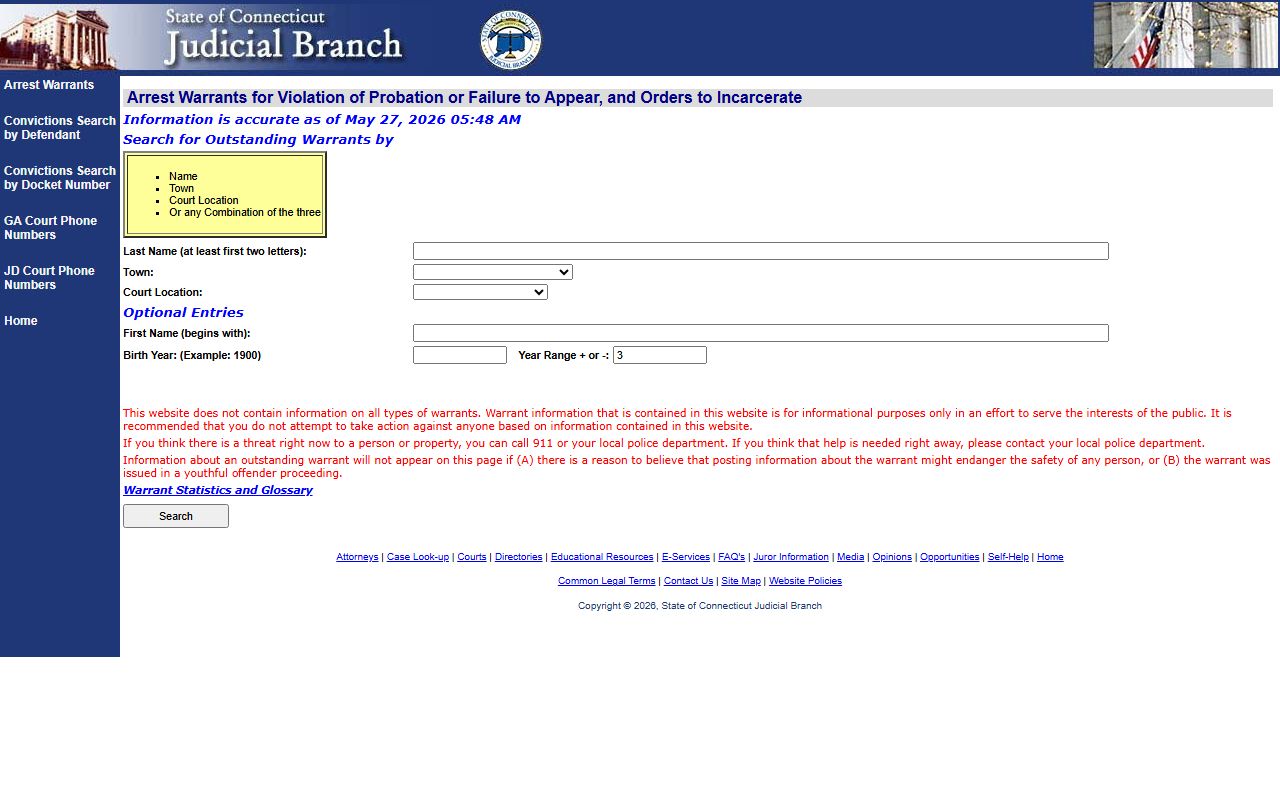
That page is the public-facing tool. It does not expose full affidavits or sealed materials, which stay inside the law enforcement system.
New London County Warrant Search Fields
The public warrant lookup uses a small set of fields. None is strictly required on its own, but combining a name with a town or birth year produces cleaner matches and fewer false hits on common names.
| Field Label | Type | Required | Notes |
|---|---|---|---|
| Defendant Full Name | Text | No | Primary name search. |
| Town | Dropdown | No | Last known town filter. |
| Court | Dropdown | No | Originating court location. |
| First Name Initial | Text | No | Narrows a broad name search. |
| Birth Year | Text | No | Year only. |
| Birth Year Range | Text | No | Allows an age or year range. |
The Office of Policy and Management explains that people can search outstanding violation of probation warrants by name, town, court location, or any combination of the three.
What a New London County Warrant Record Shows
A public warrant result returns a limited set of fields. It is built for awareness, not for full case discovery, so it leaves out the affidavit and supporting materials. The fields below are what a public-facing result may include.
| Field | What It Shows |
|---|---|
| Defendant Name | The person named in the warrant. |
| Birth Year | Year of birth used to confirm identity. |
| Last Known Address | City, state, and ZIP on file. |
| Issue Date | Date the warrant was issued. |
| Docket Number | Court case identifier tied to the warrant. |
| Court Location | The court that issued or holds the matter. |
| Warrant Type | Failure to appear or violation of probation, where shown. |
Note: Full affidavits, sealed warrants, juvenile warrants, and law enforcement PRAWN details are not all available online.
The image below is from the Office of Policy and Management arrest warrant data page.
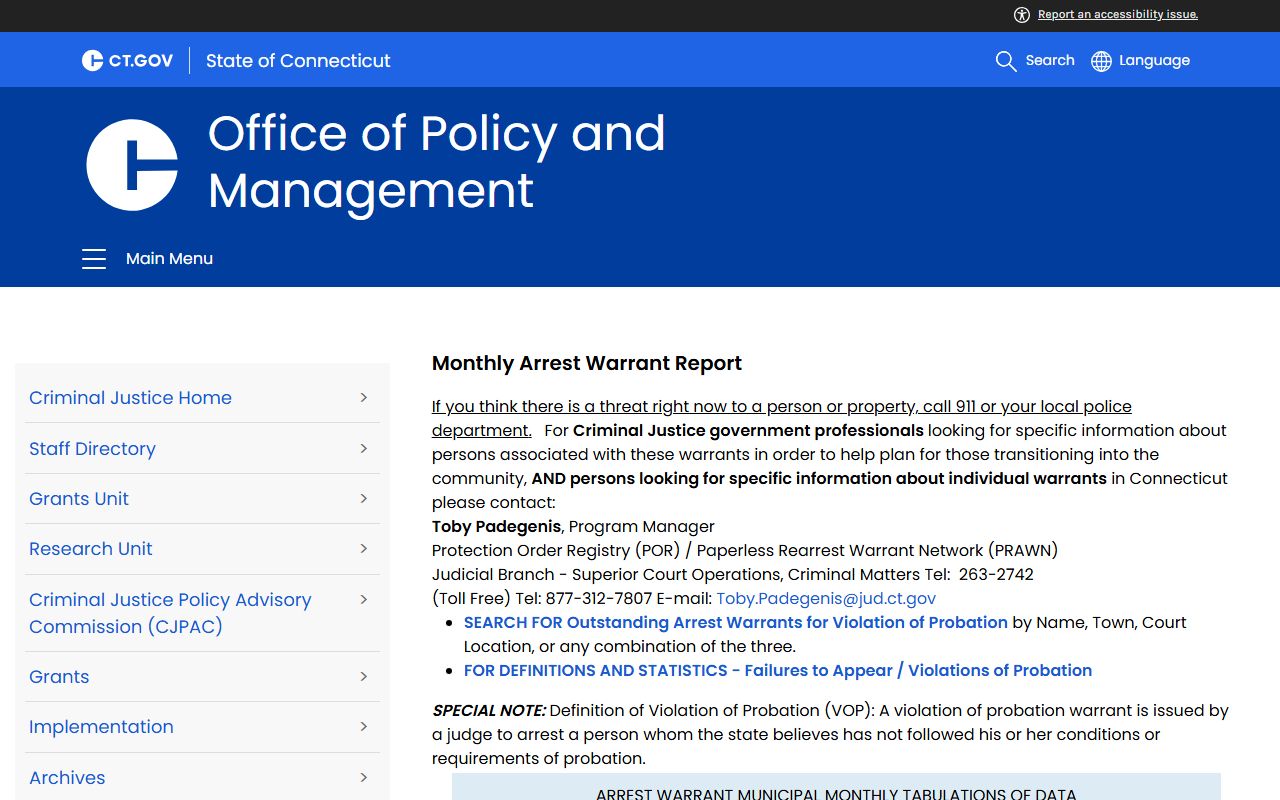
That page describes the data source and the contact route for warrant and protection order records held in the state system.
PRAWN and the Statewide Warrant System
PRAWN is more than a public lookup. The Paperless Arrest Warrant Network lets approved agencies submit warrant applications and supporting affidavits for court approval electronically. It keeps a central registry of active warrants and connects to other criminal justice systems. That is why a New London County warrant can be served by an agency far from where it was issued.
The image below is from the CJIS PRAWN overview page.
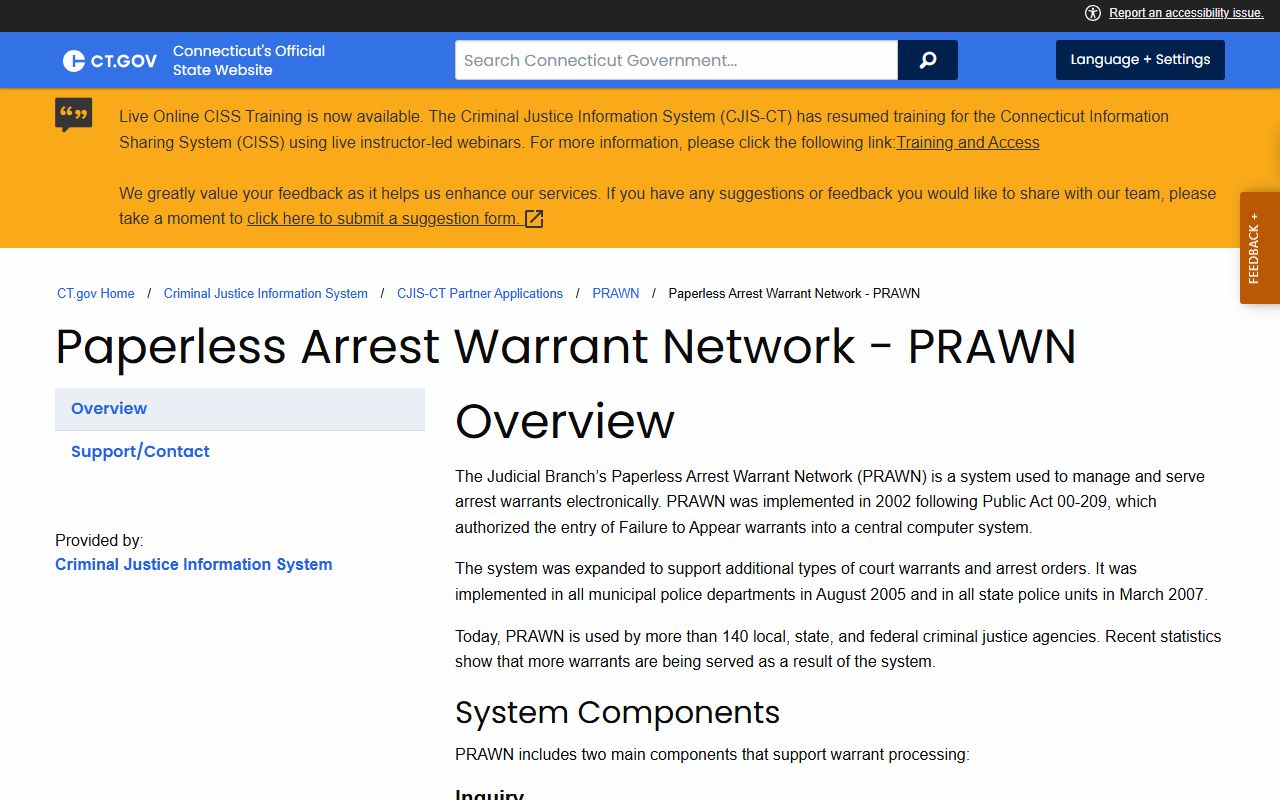
The takeaway is simple. The public search is a narrow view. PRAWN itself, with applications, affidavits, and approvals, is a law enforcement system, so the absence of a public result does not always mean there is no warrant.
What to Do If You Have an Outstanding Warrant
Do not rely on unofficial warrant sites, and do not try to clear a warrant online. The correct path runs through counsel, the clerk, and the court. The steps below reflect the official guidance for resolving an outstanding New London County warrant.
- Confirm the warrant through the Judicial Branch search, then contact the relevant clerk or an attorney rather than guessing.
- If the warrant is tied to a New London Judicial District case, reach out to counsel, the New London criminal clerk, or the Geographical Area court that holds the docket.
- For a violation of probation, contact probation and counsel, because surrender, bond, and hearing timing can differ.
- For a failure to appear, determine the missed court date, the bond amount, and whether a motion to vacate or recall is possible.
- After the court resolves the matter, confirm that the public lookup updates, since clearance may not be immediate.
Important: Talk to a lawyer before turning yourself in; counsel can arrange surrender, address bond, and protect your rights at the first court appearance.
Victim Notification and Status Updates
Crime victims often need to know when a warrant is active or when a case moves forward. In New London County, the Division of Criminal Justice provides victim advocate contacts by courthouse, and Connecticut SAVIN delivers court status updates by telephone or email. Victims should keep the defendant name, docket number, and next court date ready when calling.
The image below is from the New London crime victim information page.
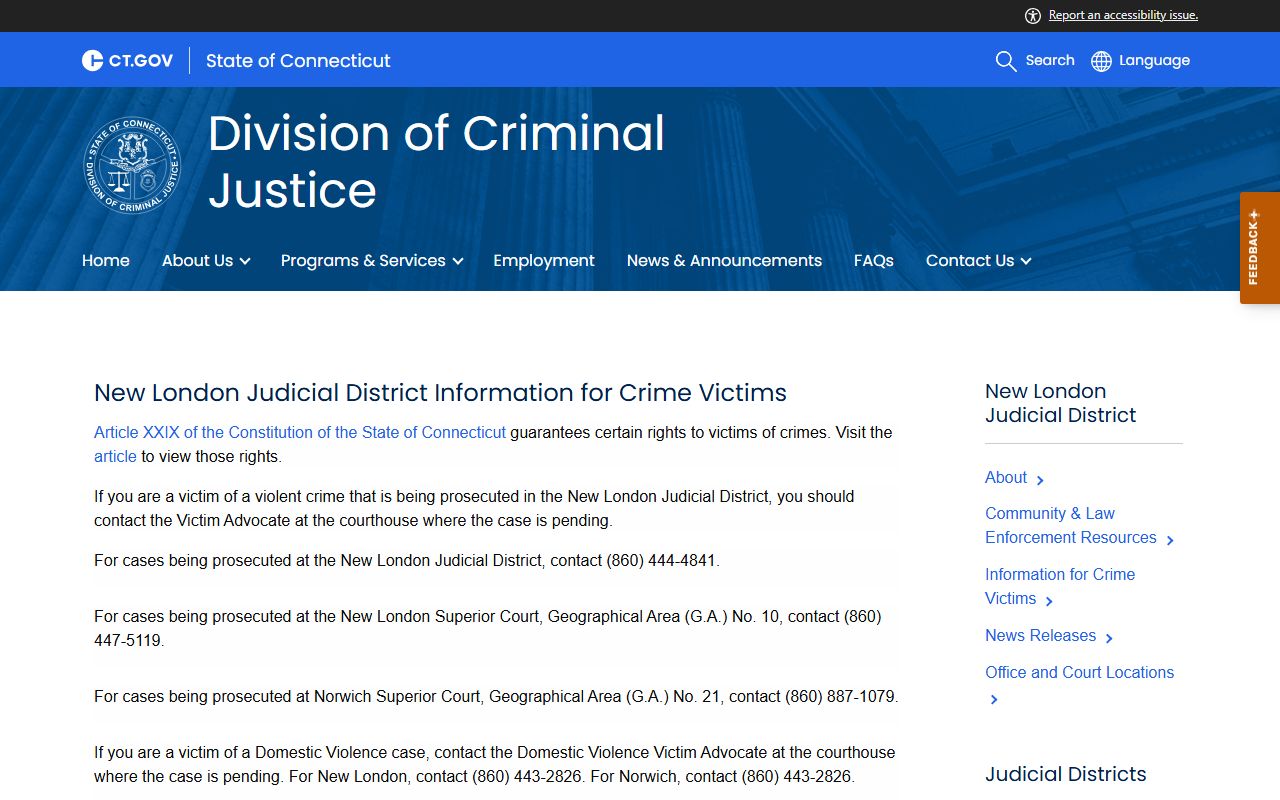
You can reach victim services through the New London crime victim information page, which lists advocate numbers for the Judicial District and the Geographical Area courts.
Restricted New London County Warrant Records
Not every warrant appears in the public search. Some are deliberately kept out of view to protect investigations, minors, and safety. Sealed warrants are hidden by court order. Juvenile warrants are confidential under the Juvenile Matters statutes. Investigative search warrant affidavits may be sealed before an arrest or while a case is active.
Federal warrants are a separate system entirely. They are handled by federal courts and agencies, not the Connecticut Judicial Branch, and they do not show in the state public lookup. If a warrant is restricted, only authorized parties can access it through the proper court or law enforcement channel.
What Happens After a Warrant Is Served
Once a warrant is served and a person is taken into custody, the case moves into the court process fast. The person may be booked, held for arraignment, or released on bond or a promise to appear. Serious matters proceed at the New London Judicial District courthouse, while many misdemeanors and lower-level felonies move through the Geographical Area courts in New London or Norwich.
Bond and pretrial services set the conditions for release. In New London County these functions are handled by Judicial Branch offices rather than a county jail, because Connecticut unified its corrections system under the state Department of Correction. A person who cannot post bond may be held at a state facility serving the region. The court docket, not the warrant search, is the place to track what happens next.
Clearing a warrant does not always update the public record instantly. After the court resolves the matter, it is worth confirming with the clerk that the lookup reflects the change, especially before relying on a clean result for any official purpose.