
Arrest Records in New London County
Arrest records in New London County are created by the police agency that makes the arrest. There is no county sheriff and no county jail in Connecticut. Arrests are made by municipal police departments in towns such as New London, Norwich, Groton, and Waterford, by the Connecticut State Police, and by other law enforcement agencies. After an arrest, the person may be booked, held for arraignment, released on bond or a promise to appear, or moved into state custody. An arrest record captures that moment: the name, the date, the arresting agency, and the charge the officer cited.
An arrest record is not the same as a criminal court record or a conviction. The arrest reflects probable cause, which is a low bar. Prosecution and the final outcome are tracked separately once charges are filed in court. Full criminal case history, including pleas, dispositions, and sentences, lives in the Judicial Branch case files covered on the New London County court records page. The arrest itself is the first link in that chain, and "criminal records" in the broad sense includes everything that follows it.
Connecticut prosecutes through the Division of Criminal Justice. The chief prosecutor for the region is the State's Attorney for the Judicial District of New London, who oversees staff at the New London courthouse, the Geographical Area courts in New London and Norwich, and Juvenile Matters in Waterford.
How to Search New London County Arrest Records
Recent arrests usually surface first through the court system, because a person taken into custody is scheduled for arraignment fast. The Connecticut Judicial Branch Criminal / Motor Vehicle Case Look-up is the main public tool. It separates searches into pending cases, convictions, daily dockets, and arrest warrants, so you pick the mode that matches what you need. A new arrest often shows as a pending case before any conviction data exists.
- Open the Judicial Branch Criminal / Motor Vehicle Case Look-up and choose the Pending Case search by defendant.
- Enter the defendant's full name. Add a first-name initial or birth year to narrow common names.
- Pick a court location if you know it, such as a New London or Norwich Geographical Area court, then run the search.
- Open the matching case to view docket number, charge text, court location, and the next court date.
For a wider name search you can also start at the Judicial Branch case look-up hub, which links every public court tool in one place. The official source of conviction and erasure rules is the state criminal records statute set, Chapter 961a of the Connecticut General Statutes, which governs how police, court, and prosecutorial records are kept and cleared.
The image below comes from that statute chapter on the Connecticut General Assembly site, which sets out criminal record erasure and dissemination rules.
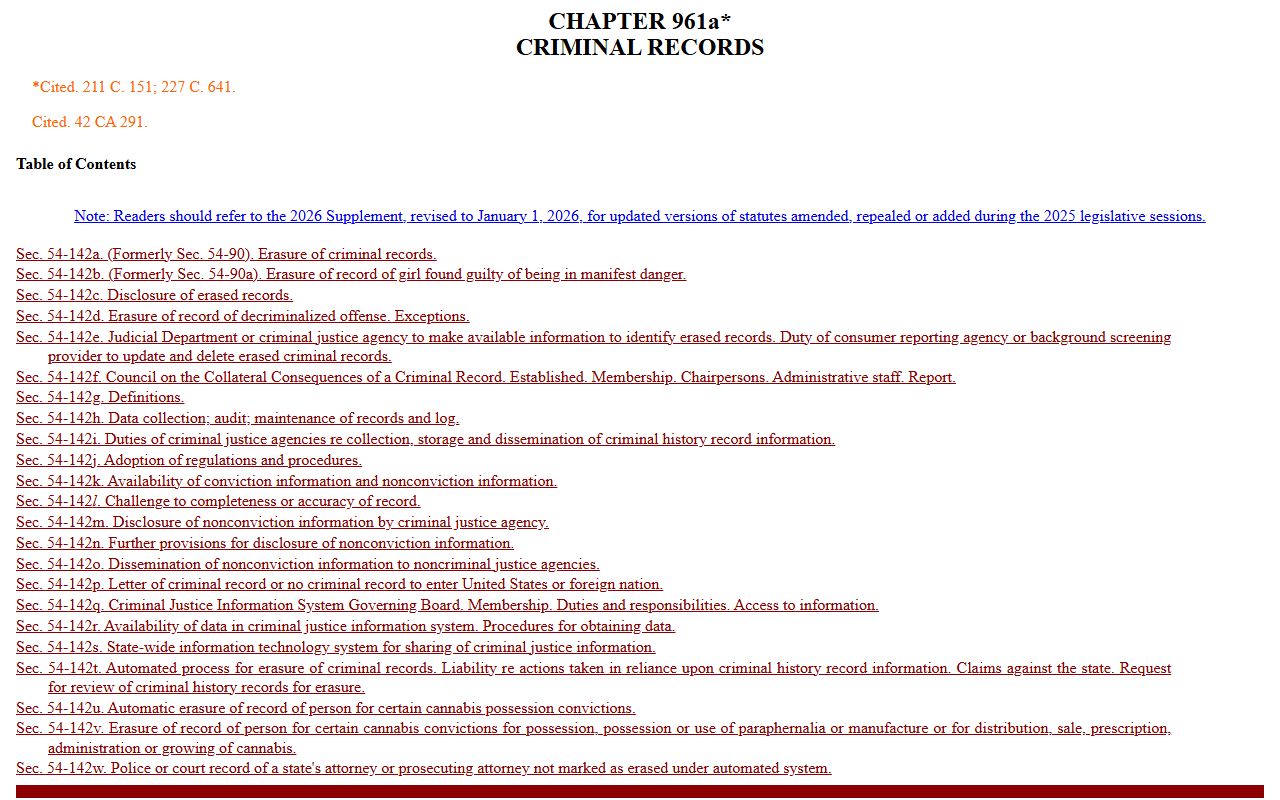
These statutes explain why a New London County arrest record can drop out of public view over time. Erasure is automatic in many cases, so the same name searched twice can return different results.
Arrest Records vs. Criminal Court Records
An arrest record is made at the moment of arrest and booking. A criminal court record begins later, when the prosecutor files charges and the clerk opens a case. The two records can describe the same incident, but they hold different information and come from different sources. Mixing them up leads people to assume an arrest means a conviction, which is not how it works.
| Arrest Record | Criminal Court Record | |
|---|---|---|
| Source | Arresting police agency | Judicial Branch / Superior Court clerk |
| Created When | Arrest and booking | Charges filed in court |
| Contents | Name, date, arresting agency, charge cited | Docket, pleas, motions, disposition, sentence |
| Where to Look | Police department or arrest log | Court records portal |
The court file is the better source once a case is underway. It tracks every event from arraignment to disposition and reflects the final outcome.
Charges vs. Convictions
Being charged is not the same as being found guilty. A charge is an accusation backed by probable cause. A conviction is the end result, reached only after a guilty plea or a finding of guilt beyond a reasonable doubt. Many New London County charges end in dismissals, acquittals, or a nolle, which is the prosecutor's decision not to pursue the charge at that time.
| Charge | Conviction | |
|---|---|---|
| Stage | Accusation at or after arrest | Plea or verdict of guilty |
| Burden of Proof | Probable cause | Beyond a reasonable doubt |
| Public Display | Shown while case is pending | Shown up to 10 years after sentencing |
The Judicial Branch posts a clear warning on its conviction lookup. Conviction data is generally shown for no more than 10 years after sentencing, unless Practice Book section 7-13 sets a shorter period. Youthful Offender cases, juvenile cases, and infraction or violation convictions are not shown at all.
Sealed vs. Erased Records
Connecticut does not use the word "expungement" for criminal record relief. The legal term here is "erasure." Sealing and erasure are not the same thing. Sealing limits who can see a file while the record still exists. Erasure goes further. Under the state erasure law, eligible records are treated as if the arrest never happened for many purposes, and a person may lawfully say under oath they were not arrested in that proceeding.
| Sealed | Erased | |
|---|---|---|
| Visibility | Hidden from public, file still exists | Removed from public access, treated as if it never occurred |
| Law Enforcement | Limited access by order | Very limited; restricted by statute |
| Legal Basis | Court order under Practice Book section 42-49A | C.G.S. section 54-142a and Clean Slate rules |
| Triggers | Judge grants a motion to seal | Dismissal, acquittal, nolle after the waiting period, pardon, or automated Clean Slate erasure |
Erasure can happen by operation of law, sometimes automatically through the Clean Slate process. Disclosure of erased records is restricted by C.G.S. section 54-142c, which is why a case can quietly disappear from the public lookup.
Mugshots and Booking Photos
A booking photo, or mugshot, is taken by the arresting agency during processing. In Connecticut there is no statewide public mugshot gallery tied to a county jail, because the state runs corrections rather than counties. Booking images, when released, come from the police department that made the arrest or, for people in custody, from the Department of Correction record where an image may appear.
Third-party mugshot sites are common and unreliable. They scrape images, rarely update them after charges are dropped, and sometimes charge to remove a photo. An arrest photo on one of those sites does not prove a current case or a conviction. For accurate status, the court docket and the official agency record are the sources that matter.
Statewide Criminal Records Search
Because the courts are unified statewide, New London County criminal records are searched through state tools rather than a county clerk. The Judicial Branch conviction and pending case lookups are free and open to the public. They show docket number, charge information, court location, important dates, and conviction data within the display window. They do not function as a full background check, and a missing result does not prove a clean record.
Juvenile delinquency matters are handled in a separate, confidential track. The image below is from the Connecticut Juvenile Matters statutes, which control who may see those files.
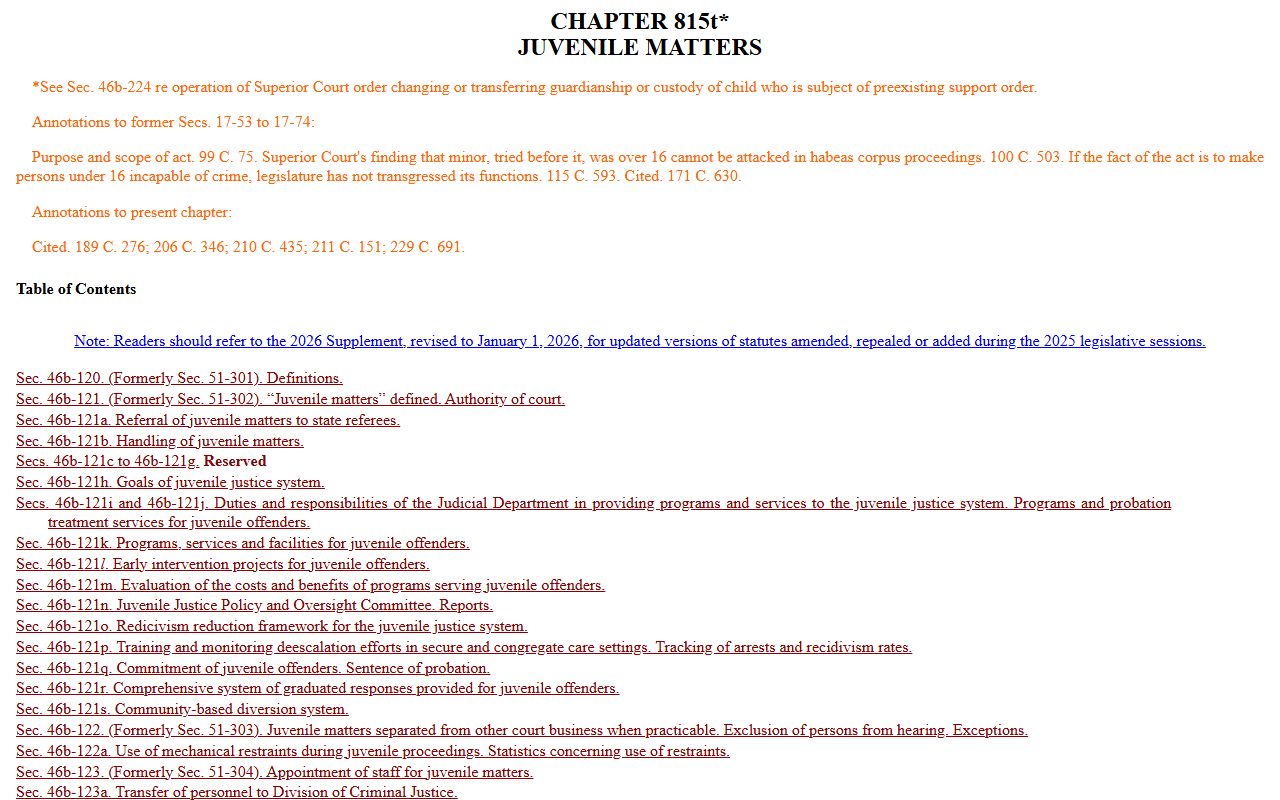
Those statutes make juvenile records confidential, with narrow exceptions, so juvenile arrests rarely appear in any public criminal search.
Who Prosecutes New London County Arrests
After an arrest, the decision to charge belongs to the prosecutor, not the police. In Connecticut the prosecutor is the State's Attorney, who leads the Division of Criminal Justice for the Judicial District of New London. The office handles serious felony cases at the New London courthouse and oversees prosecution staff at the Geographical Area courts in New London and Norwich.
The image below is from the official New London Judicial District State's Attorney page on the state portal.
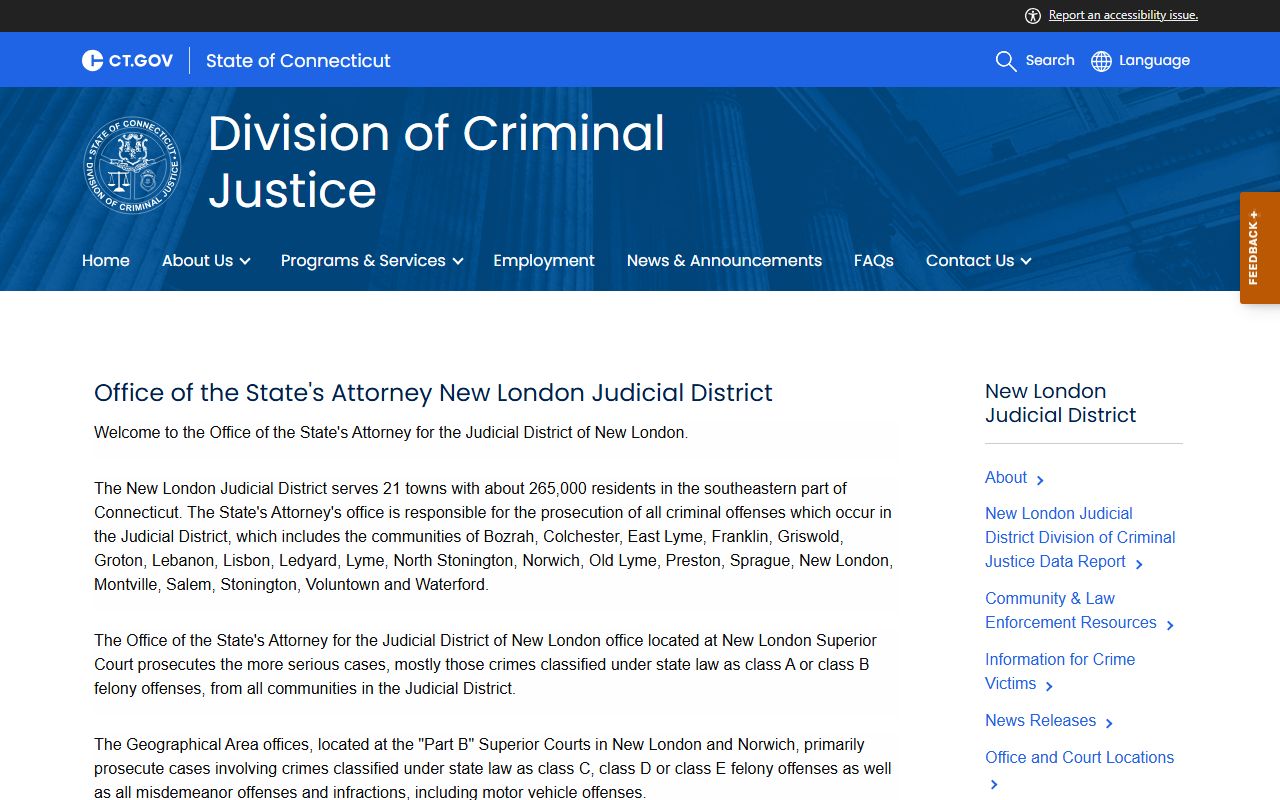
Part A of that office handles the most serious matters, including class A and class B felony offenses from across the district.
The State's Attorney also runs offices at more than one location. The image below shows the official office and court locations page.
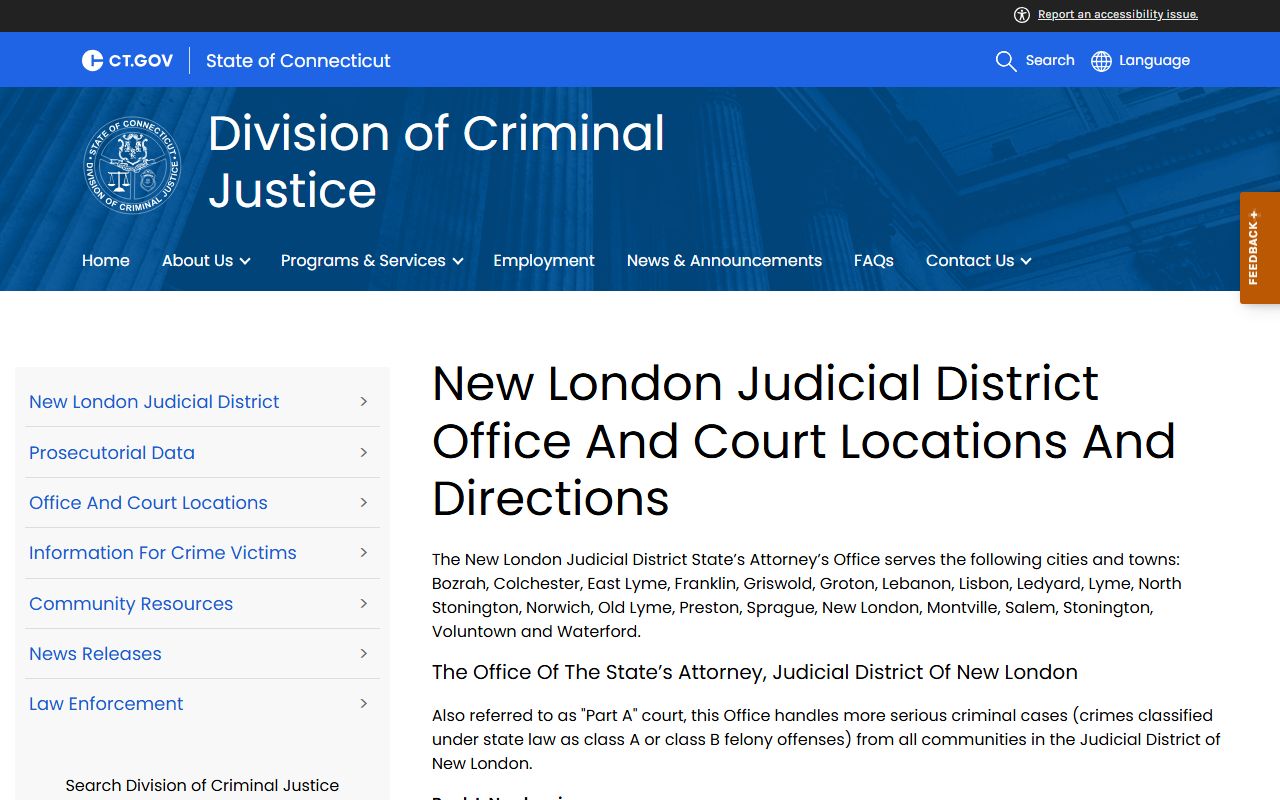
You can reach the office at the State's Attorney office and court locations page, with the main office at 70 Huntington Square in New London. Victims can request court status updates through Connecticut SAVIN rather than calling prosecutors for every question.
Background Check Considerations
A casual public lookup and a formal background check are different things. The Judicial Branch portal is a public service, not a certified criminal history. For employment, licensing, immigration, or firearm questions, an official criminal history record check is the right route, and the display limits mean a clean screen does not guarantee a clean record. Erasure, sealing, and the 10-year display window all shape what shows up.
Important: New London County Court Records is a privately operated website and is not a consumer reporting agency under the FCRA; information here may not be used for employment, credit, housing, or similar screening.
Restricted Criminal Records in New London County
Several categories of arrest and criminal records are kept from public view. The rules come from state statutes and the Practice Book, and they exist to protect privacy, safety, and fair trials.
- Juvenile records - confidential under C.G.S. section 46b-124, with access limited to parties, attorneys, agencies, and certain victims.
- Youthful Offender cases - not shown on the public criminal lookup.
- Erased criminal matters - removed from public access under the erasure law and Clean Slate rules.
- Sealed files - limited by court order, so they do not appear in the ordinary portal.
- Victim identifying information - withheld in sexual assault, family violence, and similar cases.
If you are a party, attorney, victim, or the subject of a record, your access may differ from general public access, but you may need a formal request or motion to obtain it.