
Questions About New London County Court Records
How do I search New London County court records online?
Start at the Connecticut Judicial Branch lookup hub. Choose Superior Court Case Look-up for civil, family, housing, and small claims matters. Choose Criminal / Motor Vehicle for criminal cases and motor vehicle crimes. Choose Probate Court Case Lookup for estates and trusts. New London is a judicial district in a statewide court system, so there is no separate county clerk portal. A practical search starts by naming the case type, then picking the matching tool. If a case is old, sealed, erased, or juvenile, the next step is a direct clerk request. Full detail is on the court records page.
Is there a New London County clerk of court?
Not in the county-government sense used in many states. Superior Court clerk offices here are state Judicial Branch offices. The New London Judicial District clerk's public line is 860-443-5363 at 70 Huntington Street. Town clerks handle vital and land records, and Probate Court clerks handle probate cases. This split matters because tasks that go to a county clerk elsewhere are divided in Connecticut. A docket copy goes to Superior Court. A marriage certificate goes to a town or the state. A probate file goes to the right Probate Court. See the clerk of court page for the court side.
Where is the New London courthouse?
The New London Judicial District Superior Court is at 70 Huntington Street, New London, CT 06320. Official directions say the Huntington Street entrance is closed and visitors should use the rear entrance off Cottage Street. Geographical Area 10 is at 112 Broad Street, New London. The historic 70 Huntington Street building is the primary district courthouse, while GA 10 handles assigned criminal and motor vehicle matters. Family clerk functions tie to 1 Courthouse Square in Norwich. Check your summons or docket for the exact address, because district business can route to more than one building. The Superior Court page has the building breakdown.
What court handles criminal cases in New London County?
Major felony matters are heard at the New London Judicial District courthouse. Other felonies, misdemeanors, and motor vehicle criminal matters often run through Geographical Area courts such as GA 10 in New London or GA 21 in Norwich, depending on town and charge. Motor vehicle matters can be paid through the Centralized Infractions Bureau, heard in a GA court, or handled at a district location depending on severity. Use the docket or notice, not just the arrest town, to find the correct courthouse. For arrest and charge details, see the arrest records page.
How long do criminal convictions stay online?
The Judicial Branch criminal lookup notice says conviction information is generally shown for no more than 10 years after sentencing, unless Practice Book section 7-13 sets a shorter period. Youthful Offender cases, juvenile cases, and infraction or violation convictions are not shown. The notice also warns that criminal history can change daily because records may be erased, corrected, pardoned, or otherwise modified. So an online search is not a permanent archive, and a missing result does not prove a clean history. For background-check limits and erasure, see the arrest records page.
Why did a criminal case disappear from search results?
The Judicial Branch warns that criminal history can change daily because of erasures, corrections, pardons, and other changes. If a record is erased under state Clean Slate rules, it generally stops appearing in public searches. A disappearance can also mean the search was too narrow, the case moved between pending and disposed categories, the docket number was wrong, or the matter is restricted. For a specific missing case, contact the clerk with the defendant name, year of birth, docket number, arresting agency, and approximate court date. The court records page explains display limits in more depth.
Can I search probate records online?
Yes. Use the Connecticut Probate Court Case Lookup. The Probate Courts state that case data runs from January 5, 2011 to present for decedent estates and trust matters. Older data is incomplete and may need direct court or State Library contact. The lookup filters by case type, district, status, first name, and last name. Clicking a case number can show fiduciary contact information, and clicking the district name shows court contact information. For certified copies, accountings, or restricted matters, call the probate court. See the probate records page for the local districts.
Which probate court serves New London?
It depends on the town. New London Probate Court serves New London and Waterford. Norwich Probate Court serves Norwich and several northern towns. Southeastern CT Regional Probate Court serves Groton, Ledyard, Mystic, North Stonington, and Stonington. Niantic Regional Probate Court serves East Lyme, Montville, Niantic, Old Lyme, and Salem. The New London Regional Children's Probate Court is a separate court at One Union Plaza in New London. Use the Probate Court Locator and the decedent's residence or the matter's town to confirm the right court before filing. The probate records page lists each district.
Is there a New London County jail roster?
No official county jail roster exists, because Connecticut unified county jails and state prisons under the Department of Correction in 1968. Use the Connecticut DOC inmate search and the facility pages for Corrigan Correctional Center and York Correctional Institution. Corrigan serves courts in Danielson, New London, Norwich, and Windham and holds both pretrial and sentenced offenders. York in Niantic is the statewide women's institution. The absence of a county roster is a structural Connecticut feature, not a missing local page. The inmate records page covers the DOC search.
What facility serves New London courts?
Corrigan Correctional Center in Uncasville serves Superior Courts in Danielson, New London, Norwich, and Windham and holds pretrial and sentenced offenders. Its page lists 986 Norwich-New London Turnpike, phone 860-848-5700, and Level 3/4 security. York Correctional Institution in Niantic is the statewide women's institution at 201 West Main Street, phone 860-451-3001, Level 2-5 security. Because DOC placement can change, the inmate search and a facility phone call beat assuming the nearest building. Visiting and custody details are on the inmate records page.
How do I check for an outstanding warrant?
Use the Judicial Branch arrest warrant search linked from the Criminal / Motor Vehicle page, or the state arrest warrant data page. The public search supports name, town, court location, first initial, and birth year. For safety and accuracy, confirm any result with counsel or the court. The public tool is not the same as full law-enforcement access, and not every affidavit, sealed warrant, or juvenile warrant appears online. If a result shows up, note the docket number, court, issue date, and warrant type, then call an attorney before going to court. See the warrant records page for resolution steps.
How do I pay a traffic ticket?
Use the Centralized Infractions Bureau portal and enter the complaint ticket number. If a new ticket does not appear, the Judicial Branch says to try again in three days, because police ticket data can take 7 to 30 days to enter. If it still does not appear, call CIB at 860-263-2750 or 866-542-0010, Monday through Friday, 9:00 a.m. to 5:00 p.m. A failed online transaction leaves the ticket pending, so you must still pay or plead not guilty by the answer date. The traffic court records page explains the full process.
Where do I get a marriage license?
Get the license from the vital records office or town clerk in the town where the marriage will take place. Both spouses-to-be must appear in person. The Department of Public Health lists the Connecticut marriage license fee as $50. Do not default to New London City Hall unless the ceremony will be in New London. For a wedding in Groton, Norwich, Waterford, Stonington, or another town, use that town's office. After the ceremony, the license is filed there and becomes the marriage certificate. Certified copies follow from authorized town or state offices. See the town clerk page for vital records.
Where do I get a divorce decree?
The Department of Public Health does not keep divorce decrees. Contact the Superior Court where the divorce or civil union dissolution was granted. For New London Judicial District family matters, the family clerk public line is 860-887-3515 at 1 Courthouse Square, Norwich. A marriage certificate and a divorce decree are different records. When requesting a decree, give the parties' names, the approximate judgment date, the docket number if known, and the court location. Some family file contents stay restricted even when the judgment exists. The marriage and divorce records page has the request steps.
Are juvenile court records public?
Generally no. State law makes juvenile matter records confidential, with listed exceptions for parties, attorneys, agencies, certain victims, and court orders. The Judicial Branch criminal lookup also says juvenile cases are not shown in the public criminal and motor vehicle lookup. A parent, guardian, attorney, agency employee, adult subject of the record, or victim may have specific access rights, but general internet access is not the norm. If a juvenile matter is needed for a legal proceeding, use the court process rather than a search engine. The public records page covers confidentiality rules.
Can I get help if I do not have a lawyer?
Yes. Use the Judicial Branch Court Service Centers, Public Information Desks, self-help pages, and law libraries. The New London Superior Court Public Information Desk is at 70 Huntington Street, phone 860-444-4800 extension 4027. Court staff can give procedural information but not legal advice. Services can include forms, docket information, public computers, printers, e-filing help, and notary services. For legal advice or representation, contact Connecticut Legal Services, Statewide Legal Services, a lawyer referral service, private counsel, or the public defender for a qualifying criminal matter. The public records page links more help resources.
Does Connecticut have county courts?
Not in the modern operational sense. Connecticut has historical counties, and people still search by "New London County," but the court system runs through the state Judicial Branch. The trial court is the Superior Court. New London is a judicial district. Probate Courts are separate local districts. Town clerks keep local non-court records, and the state Department of Correction handles incarceration. So a search by county is fine for intent, but the correct office is a state court, a Probate Court, a town clerk, or a state agency. The clerk of court page explains the structure.
Self-Help Tools for New London Records
The Judicial Branch keeps a central self-help hub for people handling their own matters. The Connecticut Judicial Branch self-help page gathers guides, forms, and instructions for divorce, small claims, housing, and other case types.
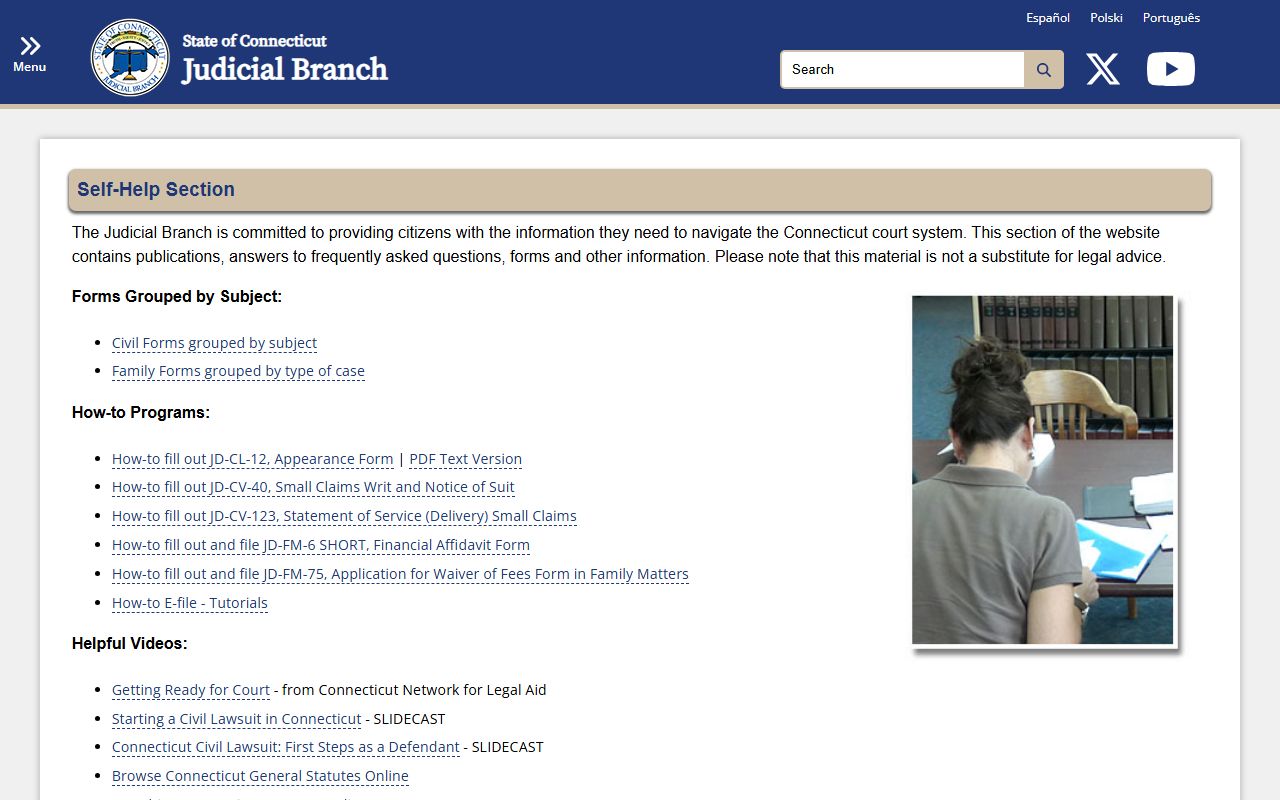
That hub is a strong first stop before a New London County court records question reaches a clerk. It points self-represented people to the right form and the right court. For broader access rules, the public records page explains what is open and what is restricted.
Legal Aid and Attorney Help
For people who need a lawyer or low-cost civil legal help, the state lists income-eligible programs. The Connecticut legal assistance resource page names civil legal service providers and how to reach them.
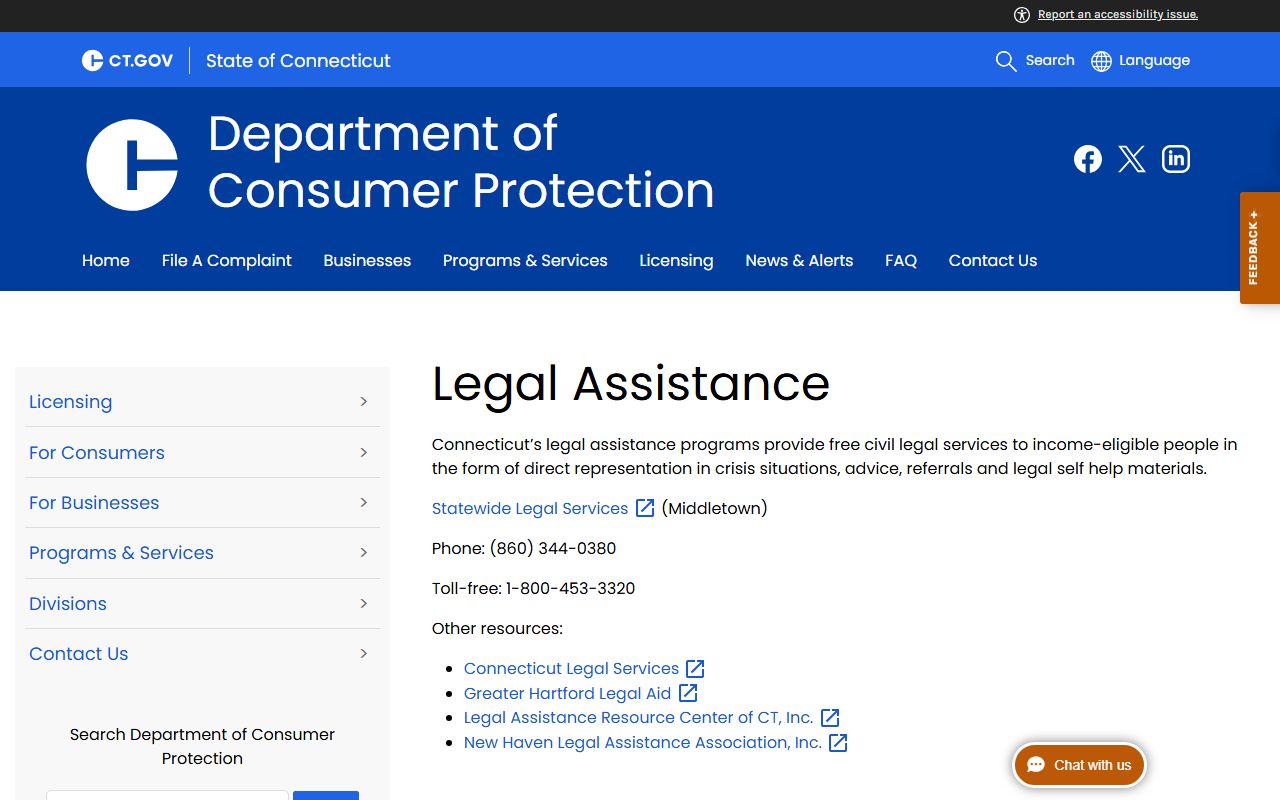
Those programs are separate from the public defender system, which handles qualifying criminal matters. Civil legal aid generally runs through Connecticut Legal Services and Statewide Legal Services. For criminal cases, the arrest records page explains how indigent defense works in the New London Judicial District.
Still Have Questions?
For the right office, see Clerk of Court. For broader access rules, see public records. For records-by-topic, browse court records, criminal records, inmate records, warrant records, marriage and divorce, or probate.