
About the New London County Clerk's Office
The New London County clerk of court is not one elected officer. Connecticut unified its trial courts under the state Judicial Branch, so Superior Court files for the region are held by state clerk offices that serve the New London Judicial District. There is no county jail clerk and no county recorder of deeds in this role. The chief clerk and the staff under that office manage case files, accept filings, take fee payments, and issue certified copies.
The Judicial Branch directory lists Steven Lombardi as Chief Clerk for the Judicial District at New London and Timothy Furman as Deputy Chief Clerk. Caseflow coordinators handle each track: Cassandra Mohan for civil, Cameron MacKenzie for criminal, and Christopher Hodgkinson for family matters in Norwich. The main public information line for civil work sits at the historic courthouse on Huntington Street. Hours follow the standard court schedule.
New London Judicial District Superior Court Clerk
Chief Clerk: Steven Lombardi
70 Huntington Street
New London, CT 06320
860-443-5363
Criminal Clerk's Office: 860-447-0893
Mon-Fri 9:00 a.m.-5:00 p.m.
What the New London County Court Clerk Does
The clerk's office is the records hub for Superior Court cases in the district. Staff file pleadings, maintain the official case file, schedule short calendar and court events, collect filing and copy fees, and issue certified copies for proof in legal and government settings. The office does not give legal advice. It also does not hold land records or birth, marriage, and death certificates, which belong with the town clerk.
- Accept and file civil, family, housing, small claims, criminal, and motor vehicle papers.
- Keep the official court file and docket for each case.
- Issue plain and certified copies of court documents.
- Take filing fees, copy fees, and other court payments.
- Route public information questions about case status and court dates.
Court Service Centers and Public Help
The Judicial Branch runs Court Service Centers in Superior Courthouses across the state, and the New London courthouse is one of them. The Connecticut Judicial Branch Court Service Centers page describes the staff support, public computers, and self-help tools offered to people without a lawyer.
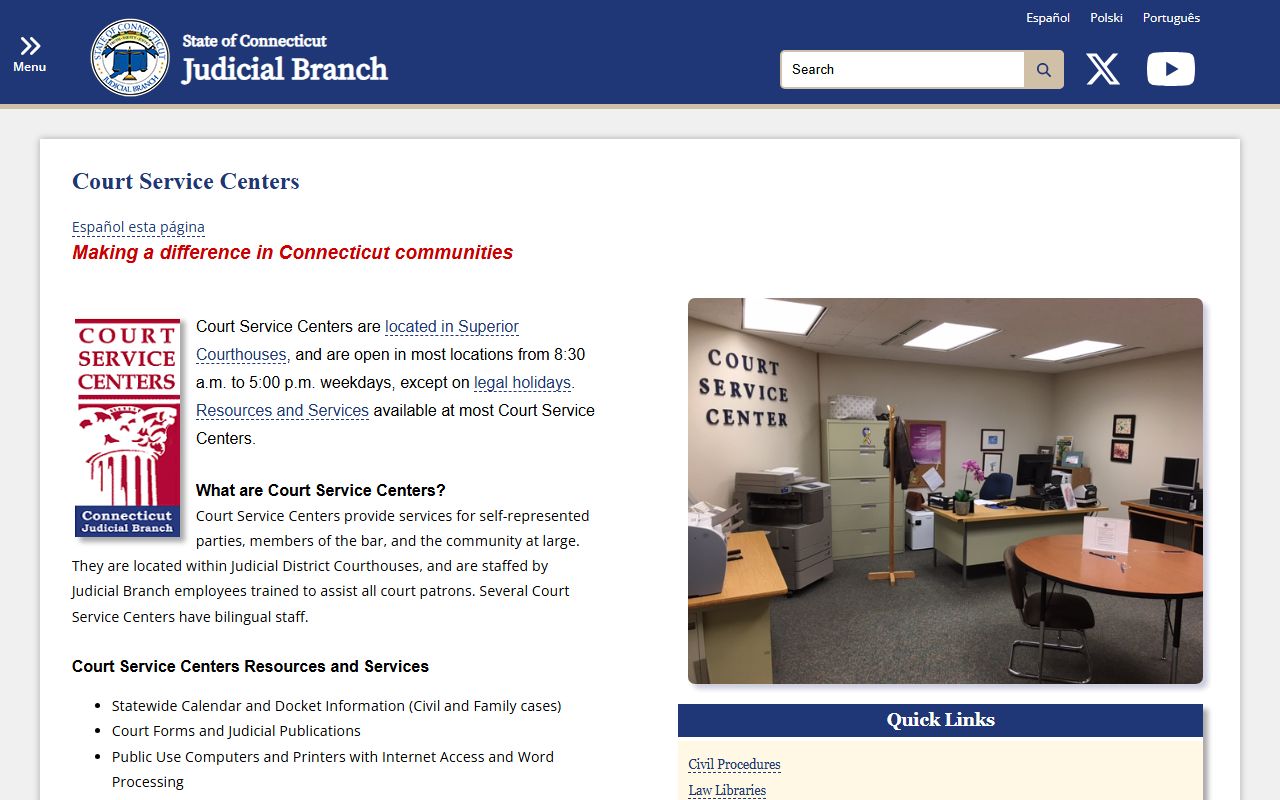
Court Service Center staff can show a person how to file a form or use the case lookup, but they cannot tell you what legal argument to make. The center is a good first stop before a New London County court records request reaches the clerk's counter.
Most centers offer statewide calendar and docket information, court forms and publications, public-use computers and printers, internet access, word processing, e-filing help, a copier, fax, scanner, telephone, workspace, and notary services. Several have bilingual staff. The shared email for these centers is Court.ServiceCenter@jud.ct.gov.
How to Request a Certified Copy
A certified copy is a court-stamped reproduction that proves a document is a true copy of the original file. Banks, employers, immigration offices, and other courts often demand a certified copy rather than a screen print. An online lookup result is closer to a plain copy and does not carry the clerk's seal. The clerk's office issues certified copies for documents in cases it holds.
- Identify the docket number and case type. Use the Judicial Branch lookup hub to confirm the docket. Write down the full docket number, the party names, and the court location.
- Pick the right clerk office. Civil, family, housing, and small claims copies route through the New London Judicial District clerk. Criminal and motor vehicle copies route through the Criminal Clerk's Office. Family copies may route to the Norwich location.
- Submit the request with payment. Contact the clerk by phone or in person during court hours. Give the docket number, party names, the document you need, and how many certified copies you want. The clerk confirms the fee before you pay.
- Pick up or receive the copy. Ask whether the office allows in-person pickup or mail return for your record type, and confirm turnaround when you submit.
Note: A search that returns no result does not always mean no record exists, because a file may be sealed, erased, or too old for the online index.
Records Request Field Inventory
Having the right details ready speeds a copy request. The clerk needs enough to find the exact file, confirm whether it is public, and prepare the correct copy. The fields below cover what comes up in a typical New London County court records request.
| Field | Required | Notes |
|---|---|---|
| Docket Number | Strongly recommended | Connecticut docket format combines location, category, year, and number; the fastest way to locate a file. |
| Party Names | Yes | Plaintiff and defendant, or petitioner and respondent; both names help for family cases. |
| Case Type / Location | Yes | Civil, family, housing, small claims, criminal, or motor vehicle; sets which clerk and building handle it. |
| Document Type | Yes | Name the exact paper: judgment, order, motion, or full file; certified or plain copy. |
| Number of Copies | Yes | Affects total cost; confirm the per-copy fee with the clerk. |
| Requester Contact | Yes | Name, phone, and mailing address if the clerk mails the record or needs to follow up. |
The New London Courthouse Clerk Counter
The primary clerk counter sits inside the historic courthouse at 70 Huntington Street. The New London Superior Court information page describes the building, the entrance, and what visitors should expect on a court day.
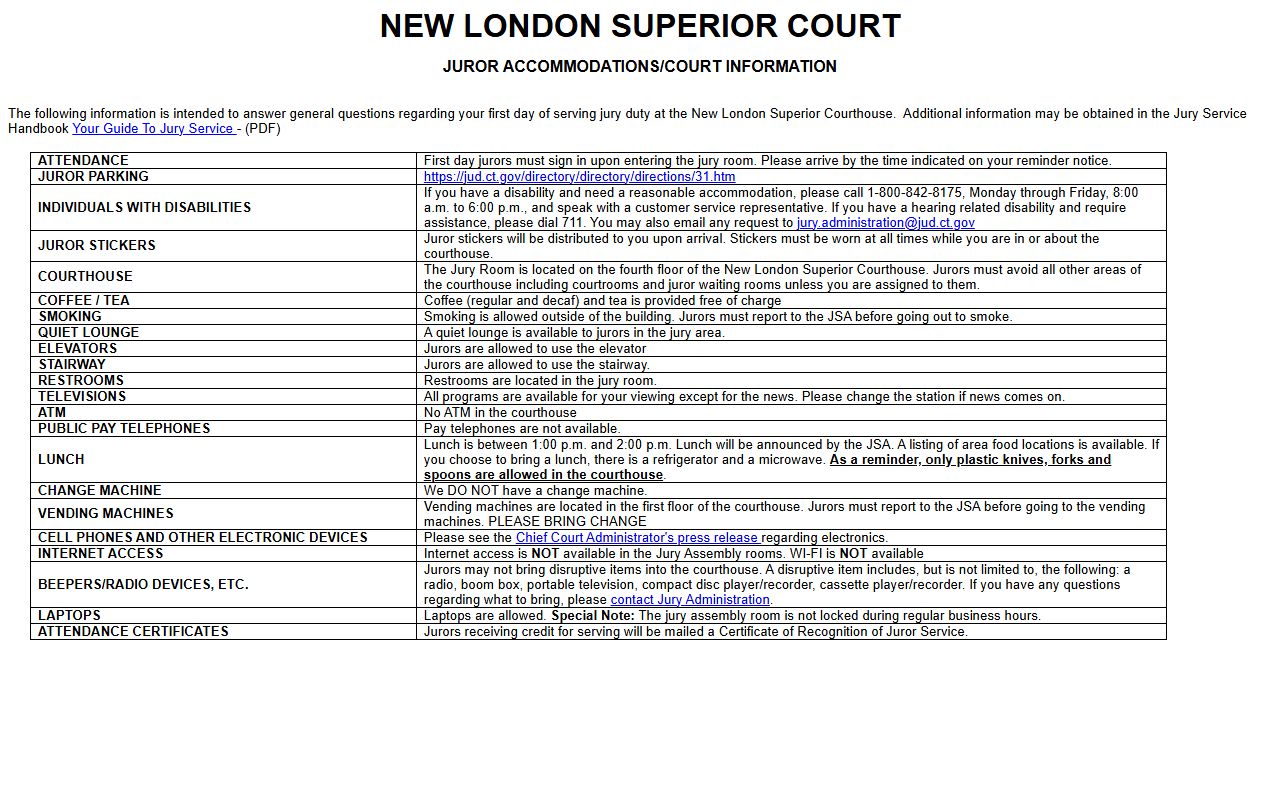
That official page is the place to confirm current entrance rules before visiting the New London County court clerk. The Huntington Street entrance is closed, and the public uses the rear entrance off Cottage Street. There is no ATM in the building, so bring an accepted payment method for any copy fee.
New London County Clerk Fees
Court copy and certification charges are set by the Judicial Branch and can change, so confirm the current amount with the clerk before you pay. Several related record fees are easier to pin down. The table mixes verified state record fees with a clear note where the Superior Court per-page charge was not published in the research sources.
| Item | Amount |
|---|---|
| Superior Court copy / certification | Confirm with clerk |
| Town birth, death, marriage, or civil union certificate | $20 per copy |
| State death, marriage, or civil union certificate | $20 per copy |
| State birth certificate | $30 per copy |
| DMV certified driving history | $20 |
The vital record and DMV fees come from the Connecticut Department of Public Health and the Department of Motor Vehicles. The clerk's office does not issue those records. They belong with the town clerk or the relevant state agency, which is why the fee picture is split.
Search Portals the Clerk Supports
Before calling the clerk, many people can find what they need online. The Judicial Branch posts free public case lookup tools, and each one covers a different case type. Using the wrong tool can return a false "not found" result, so match the portal to the record.
| Portal | Covers | How to Search |
|---|---|---|
| Superior Court Case Look-up | Civil, family, housing, small claims | Party name or docket number; narrow by location |
| Criminal / Motor Vehicle Look-up | Criminal and motor vehicle cases | Convictions, pending case, daily docket, or warrant search |
| Judicial Branch Lookup Hub | All Superior Court case-type tools | Pick the system that fits the case |
The civil portal also offers search by attorney or firm juris number, by property address, and a court events lookup. The criminal page splits convictions from pending cases and the daily docket, so a single search does not return a full history. For a deeper walk through these tools, see the court records page and the court dockets page.
Public Information and Records Access
The Judicial Branch keeps a public information resource that explains how court data is displayed and what limits apply. The Connecticut Judicial public information page lists Public Information Desks, including the New London Superior Court desk at 70 Huntington Street.
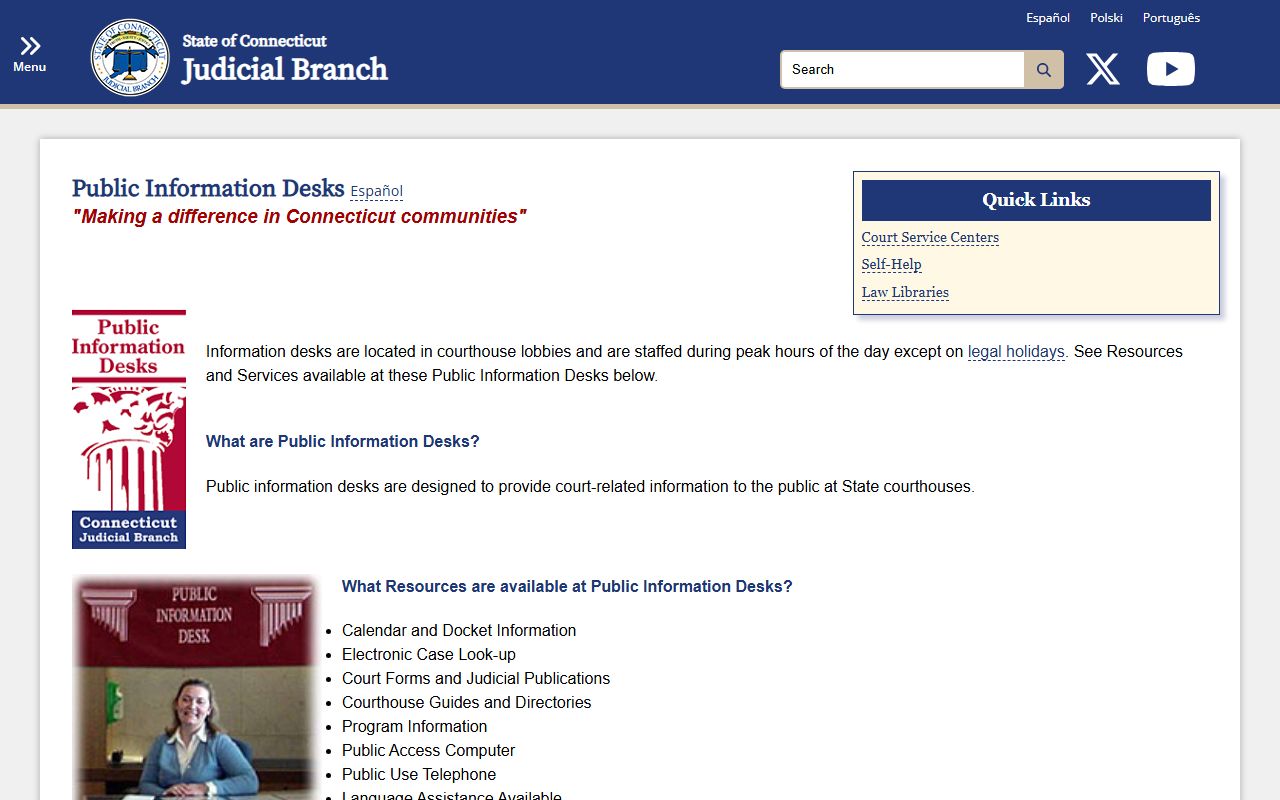
That desk can provide calendar and docket information, electronic case lookup, court forms, and notary services. The New London Public Information Desk line is 860-444-4800, extension 4027. Staff there support the clerk's office by handling routine New London County court records questions at the lobby level.
Clerk of Court vs the Town Clerk
The single most common mix-up in Connecticut is treating the court clerk and the municipal town clerk as one office. They are separate by law and by function. The Superior Court Clerk holds case files, dockets, judgments, and criminal matters. The town clerk holds land records, vital records, trade names, notary records, and maps for a specific town.
A foreclosure docket is a Superior Court case, but the deed behind it sits with the town clerk. A divorce decree comes from the Superior Court family clerk, while the marriage certificate comes from the town where the wedding happened. Picking the wrong office wastes a trip. For land and vital records, use the town clerk page. For probate estates and trusts, the local Probate Court is separate again, covered on the probate records page.
Quick routing: Court case file or certified judgment goes to the Superior Court Clerk. Deed, mortgage, or birth and death certificate goes to the town clerk. Estate, trust, or conservatorship goes to the Probate Court.