
What Probate Covers in New London County
Probate courts settle what happens to a person's affairs at key moments in life and after death. They handle decedents' estates, both with a will and without one. They oversee trusts. They appoint conservators for adults who cannot manage their own affairs and guardians for minors and protected persons. They also handle name changes and a range of children's matters. The work is sensitive, and the records follow the people involved.
In Connecticut, probate is not part of the Superior Court. The Probate Courts are separate, with their own elected judges and clerks. Several probate districts serve the towns of New London County, including Norwich Probate Court and the Southeastern Connecticut Regional Probate Court. Each district covers a defined set of towns. The right court depends on where the person lived or where the matter is tied.
The statutes that govern these courts sit in the Connecticut General Statutes. The state publishes the probate court procedure statutes, which set out fees, accountings, and appeal routes.
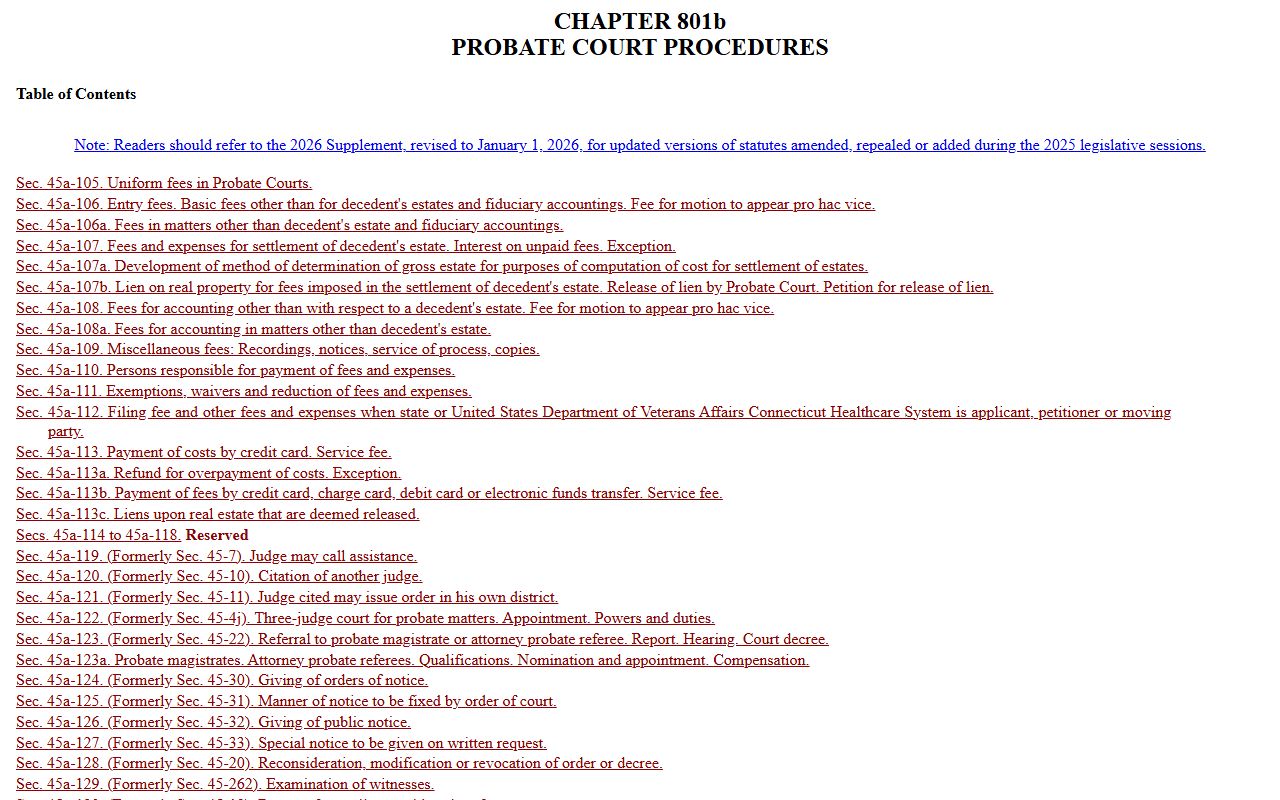
That statute chapter is the legal backbone for how New London County probate courts process estates and calculate fees.
Probate Terms Defined
Probate filings use words that rarely come up in daily life. A short glossary helps when reading a case file or a court notice. The terms below appear across estate, conservatorship, and guardianship matters in New London County.
- Testator
- The person who made the will. The will speaks for the testator after death.
- Executor / Fiduciary
- The person with legal responsibility for managing an estate or another person's property. An executor named in a will is one kind of fiduciary.
- Intestate
- Dying without a valid will. State law then decides how the estate is divided.
- Conservator
- A person appointed by the Probate Court to manage the affairs of an adult who cannot manage them alone.
- Guardian
- A person legally responsible for a minor or a protected person.
How to Search New London County Probate Court
Connecticut runs a single statewide probate case lookup, separate from the court systems described on the court records page. The tool covers decedent estate and trust matters. Case data runs from January 5, 2011 to the present. Searches can return older cases, but the database is incomplete before that date.
- Identify the correct probate district by the person's residence or the town tied to the matter.
- Open the Probate Court case lookup and filter by case type, district, status, and party name.
- Click a case number to view fiduciary contact information, or click a district name to view court contact information.
- For records before 2011 or incomplete online results, contact the probate court directly or the Connecticut State Library for archived material.
Note: The case type legend includes codes such as DR for a regular decedent estate, DW for a will file only, and T for a trust.
Probate Court eFiling and Access
Connecticut Probate Courts also support electronic filing. Access is not open to everyone. The system is limited to attorneys, self-represented parties, parties to a case even when represented, professional conservators, and certain state agencies. Eligible filers can start a case, file documents, serve other eFilers, receive notices, and view the court's file.
The state describes who qualifies and what eFiling can do on its probate eFiling overview.
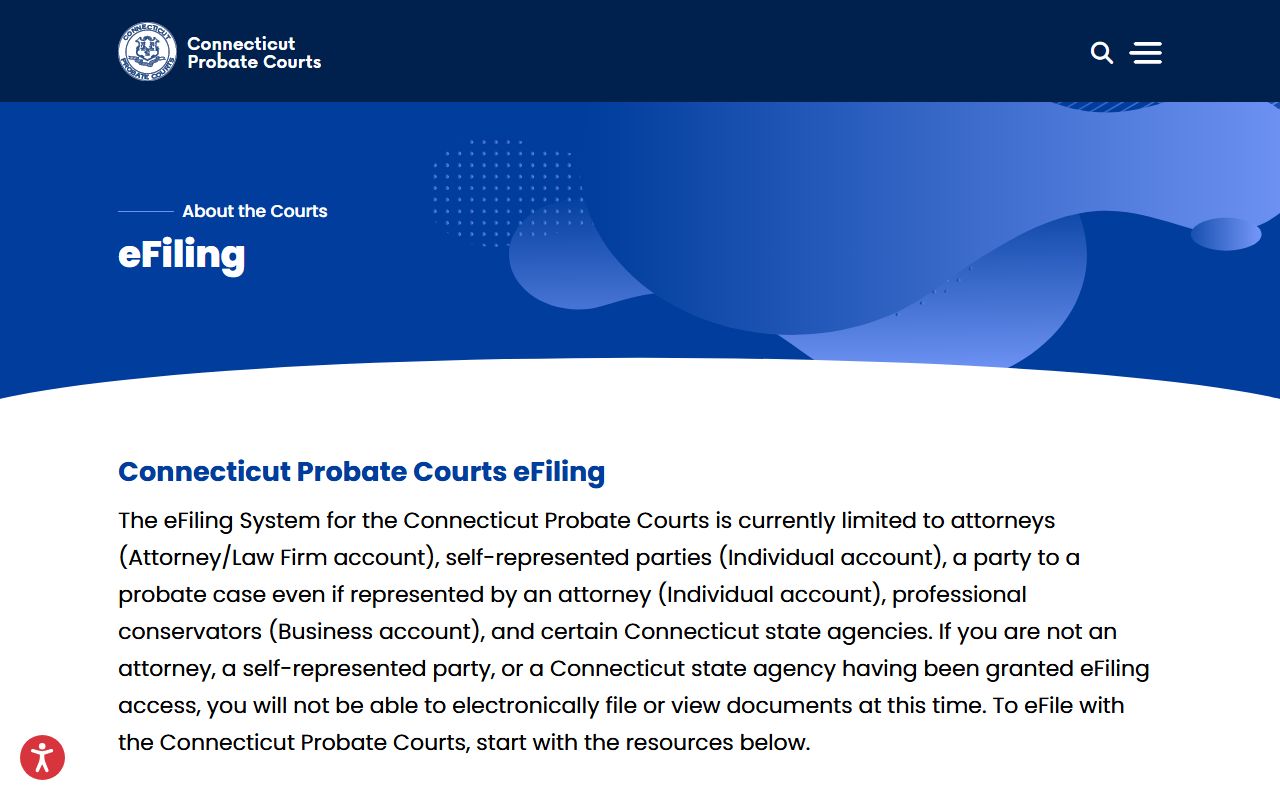
That page sets the access limits a New London County filer needs to understand before opening or viewing a probate case online.
Payment rules and service fees appear in the separate probate eFiling standards, which list accepted payment types and the per-transaction charges processed by the vendor.
Those standards confirm the eCheck and card service fees that apply to electronic probate payments across New London County districts.
Probate Courts in New London County
Several probate districts cover the towns of New London County. Each has its own judge, chief clerk, and town list. The cards below give the main contact details. The full directory sits on the state probate court locator.
Norwich Probate Court (PD-29)
100 Broadway, Room 122, City Hall
Norwich, CT 06360-0038
860-887-2160
Serves Bozrah, Franklin, Griswold, Lisbon, Norwich, Preston, Sprague, Voluntown
Southeastern CT Regional Probate Court (PD-30)
Town Hall, 45 Fort Hill Road
Groton, CT 06340
860-441-6655
Serves Groton, Ledyard, Mystic, North Stonington, Stonington
New London Probate Court (PD-31)
181 State Street, Room 2, P.O. Box 148
New London, CT 06320
860-443-7121
Serves New London, Waterford
Niantic Regional Probate Court (PD-32)
118 Pennsylvania Avenue
Niantic, CT 06357
860-739-6052
Serves East Lyme, Montville, Niantic, Old Lyme, Salem
The New London Regional Children's Probate Court, at One Union Plaza in New London, handles regional children's matters and can be reached at 860-437-6253.
Probate Filing Fees
Probate fees in Connecticut are uniform statewide and set by statute, not by each district. Estate fees are calculated on a statutory schedule rather than a flat charge. Electronic payments carry a small service fee from the payment vendor. The table summarizes the main rules.
| Item | Amount / Rule |
|---|---|
| Decedent estate fees | Calculated under C.G.S. § 45a-107 |
| Probate eCheck service fee | $1.00 per eCheck |
| Probate card service fee | Greater of $1.50 or 2.45% |
| Fee waiver / indigency | Payment not required at filing if filer represents inability to pay |
The estate fee statute is part of the same probate procedure chapter that governs accountings and appeals to the Superior Court.
What New London County Probate Records Show
A probate file builds over the life of a case. For an estate, it can hold the will, the application to admit it, the appointment of a fiduciary, an inventory of assets, creditor notices, accountings, tax documents, and the final distribution. Conservatorship and guardianship files show petitions, medical or capacity evidence, orders, and periodic reports.
Online, the case lookup shows the case number, the case type code, the person's name, the district, and the case status. Fiduciary contact details appear when you click the case number. Court contact details appear when you click the district name. Full document images are not always posted, so some records require a call or a visit to the Probate Court.
The case type code tells you a lot before you open the file. A DR code marks a regular decedent estate. DAT marks an affidavit estate, a simpler track for small estates. DT marks an estate handled for tax purposes only. DW marks a will filed for record only. The T codes mark trust matters, including living trusts and testamentary trusts. Reading the code first saves a wasted click.
How Probate Works in New London County
A probate matter follows a steady path once it starts. The work centers on the correct district and the right form, and a fiduciary carries duties throughout. The steps below outline how a typical estate moves through a New London County probate court.
- Identify the correct probate district by the decedent's residence or the town tied to the matter.
- File the correct form, such as an estate administration, affidavit estate, will filing, conservatorship, guardianship, or trust form.
- Pay the statutory fees, which for decedent estates are calculated on a schedule rather than a flat amount.
- Attend hearings or respond to notices as the Probate Court orders.
- As fiduciary, file inventories, accountings, tax documents, creditor notices, and final distribution papers as required.
If a party disagrees with a Probate Court decision, Connecticut law allows an appeal to the Superior Court under C.G.S. § 45a-186. That appeal route is the bridge between the separate probate system and the general trial court.
Restricted Probate Records
Not every probate record is open. Children's matters are confidential. Adoption files carry strong restrictions, with adult adoptee access governed by specific statutes. Mental health commitment proceedings are sensitive and may be limited by probate rules and health privacy law. Guardianship records that involve a minor can also be restricted.
When records are sealed or limited, the public lookup will not display them in full. Access then depends on your relationship to the case and any court order. If you need a restricted file, contact the Probate Court directly and be ready to show why you are entitled to it.
Confidentiality protects the people at the center of these cases. A child in a guardianship, an adult under a conservatorship, and a person in a commitment proceeding all have privacy interests the law guards. The public lookup is strongest for decedent estate and trust data, which is why those case types dominate what you can find online for New London County.