
How to Search New London County Court Records
Connecticut runs its courts as one statewide system, so the search route for New London County is the Judicial Branch, not a county office. Start at the Connecticut Judicial Branch lookup hub. From there you choose the tool that fits your case. The Superior Court Case Look-up covers civil, family, housing, and small claims matters. The Criminal / Motor Vehicle Case Look-up covers criminal cases and motor vehicle crimes. The Probate Court Case Lookup covers decedent estates and trusts. Think in terms of case type and court location, not a county clerk.
A little prep saves time. Have the full name of a party with the right spelling, or a docket number if you have one. A docket number is the most precise input. Read the disclaimer first. The Judicial Branch says the lookup pages are a public service. It tries to keep data accurate and current, but it does not warrant the data and assumes no liability for errors, omissions, availability, or compatibility.
- Open the Superior Court Case Look-up and accept the public-service disclaimer.
- Pick a search mode. Use Case Look-up by Party Name when you know a person or business. Use By Docket Number when you have the case number.
- For a name search, enter the Party Last Name and add the First Name if you have it. Narrow by Location to New London when the portal loads that list, and by Case Category and Case Type.
- Set the Name Search Type. Choose Is Equal To for exact spelling, or Contains and Sounds Like when the spelling is uncertain.
- Review the results. Open a case to see the docket, party caption, court location, and listed events. For criminal or probate matters, run the matching criminal lookup or probate lookup instead.
Note: For old, sealed, erased, juvenile, or unindexed cases, the next step is a direct clerk or probate court request rather than the online portal.
New London County Court Records Search Fields
The civil party search is the most-used tool for New London County court records. It feeds from the Superior Court party search page and covers civil, family, housing, and small claims cases. You search by party name and can narrow the result with location, category, and case-type filters. The Name Search Type radio is the field most people miss. It controls how the system matches the spelling you typed. The table below lists the fields on the party search form.
| Field Label | Type | Required | Notes / Format |
|---|---|---|---|
| Party Last Name | Text | Yes | Last name to search; the Name Search Type controls matching. |
| Party First Name | Text | Optional | Narrows a broad last-name search. |
| Location | Dropdown | Optional | Defaults to All; the location list loads in the browser. Select New London to focus results. |
| Case Category | Dropdown | Optional | Defaults to All. Filters by broad case group. |
| Case Type | Dropdown | Optional | Defaults to All. Filters by specific case type. |
| Sort Order | Dropdown | Optional | Defaults to Location. |
| Name Search Type | Radio | Yes | Starts With, Contains, Is Equal To, or Sounds Like. |
| Submit | Button | Yes | Runs the party-name search. |
The first official screen people reach is the civil party search shown here. It is the public front door to New London County civil case data.
The Superior Court civil party search page lets you enter a last name and choose how the system matches it across New London County court records.
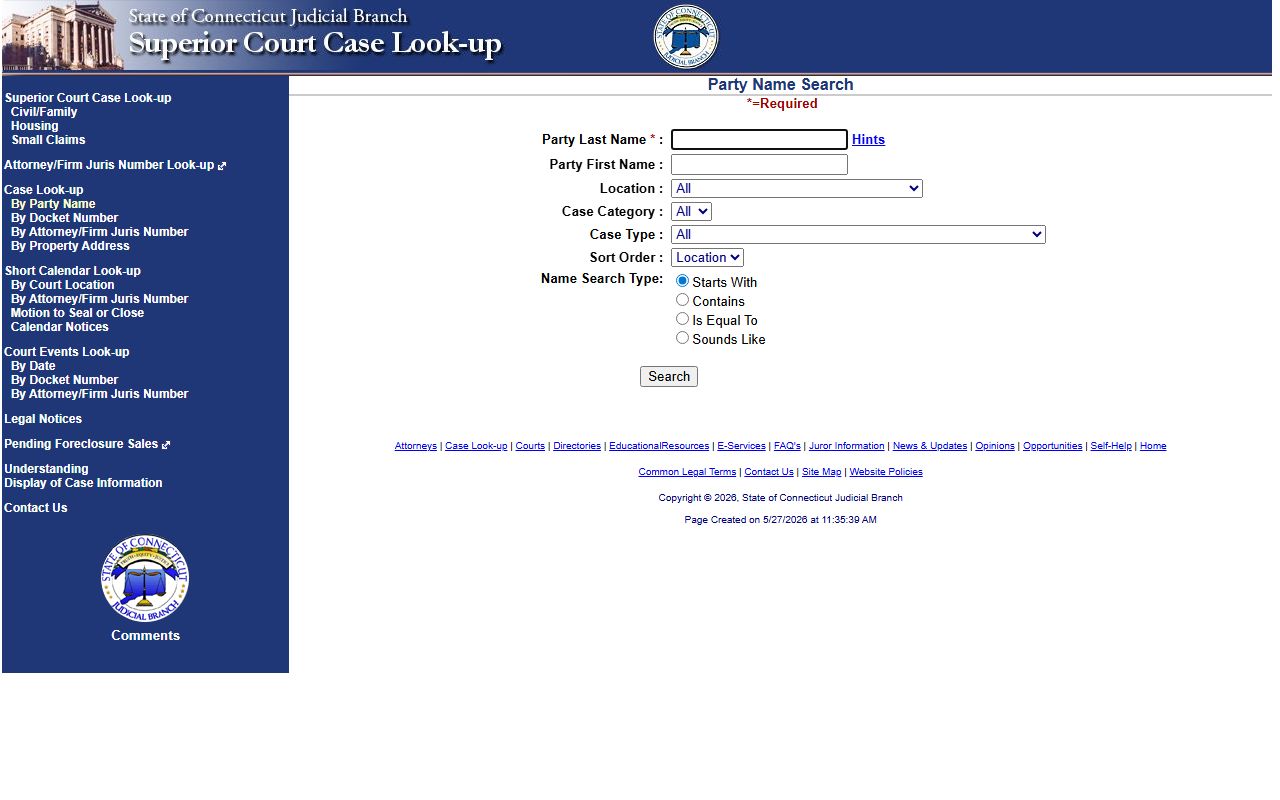
Once a name returns a hit, you click through to the case and can switch to a docket-number search for a faster, more exact pull next time.
Searching New London County Records by Docket Number
A docket number is the cleanest way to find one specific case. The civil docket lookup accepts either a full docket number or the segmented parts: Location, Category, Year, and Number. Two optional controls let you add detail. Include Party Information adds party names where they are public. Include Motions/Pleadings/Documents lists the filed papers, though full document images are not always public online. The fields below match the docket lookup form.
| Field Label | Type | Required | Notes / Format |
|---|---|---|---|
| Location | Dropdown | Conditional | Defaults to Select Location; needed when using the segmented fields. |
| Category | Dropdown | Conditional | Example value: CV for civil. |
| Year | Text | Conditional | Year portion of the docket number. |
| Number | Text | Conditional | Numeric portion of the docket number. |
| Full Docket Number | Text | Alternative | Enter the full docket number if you have it. |
| Include Party Information | Checkbox | Optional | Adds party names where public. |
| Include Motions/Pleadings/Documents | Dropdown | Optional | Visible option: ALL. |
| Search | Button | Yes | Runs the docket lookup. |
The lookup screen below is the docket-number door for New London County civil and family cases.
The Superior Court civil docket lookup takes a full docket number or its location, category, year, and number parts for New London County court records.
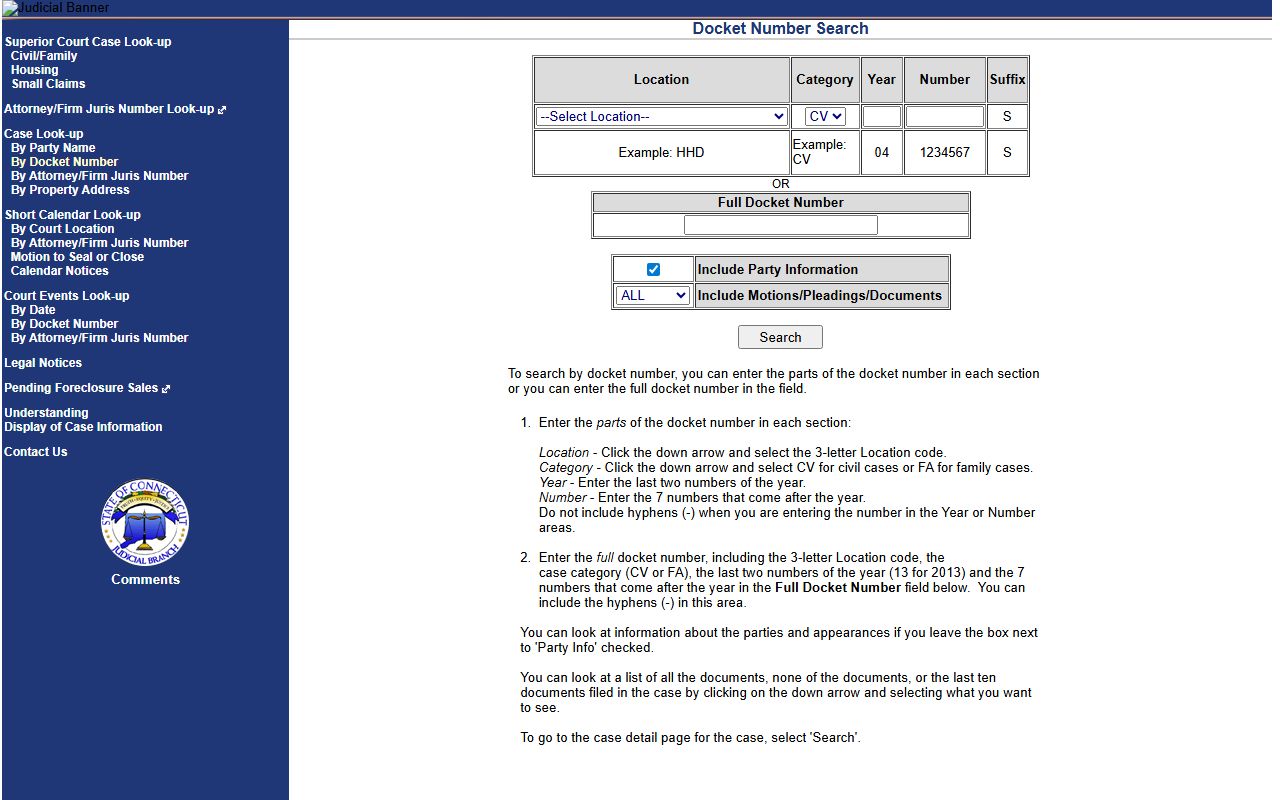
The docket view shows the case events in order, which is the fastest way to track where a New London County case stands.
Types of New London County Court Records
New London County court records span several case tracks, and each track lives in its own portal. Civil files cover lawsuits, foreclosures, and money claims in the Superior Court. Criminal and motor vehicle files cover charges, pleas, and dispositions. Family files cover divorce, custody, and support. Housing files cover landlord and tenant disputes. Probate files cover estates, trusts, conservatorships, and guardianships, and those run through a separate Probate Court system, not the Superior Court clerk.
The court that produced the record decides where you look. The Superior Court handles most civil, family, criminal, and housing matters. The Probate Courts handle estates and trusts. Knowing the type first keeps your search in the right place.
- Civil records - complaints, appearances, motions, orders, judgments, foreclosure materials, and short-calendar activity, searched through the civil inquiry portal.
- Criminal and motor vehicle records - docket, charges, plea, disposition, sentence, and conviction display within the public time limit; see the New London County arrest records page for the criminal side.
- Family records - divorce, custody, support, and parenting matters; some details are restricted to parties or need a courthouse visit.
- Housing records - landlord and tenant matters; in New London, housing case look-up online covers matters filed on or after January 1, 2017.
- Probate records - decedent estates, trusts, conservatorships, and guardianships through the New London County Probate Court system.
- Traffic infractions - payable tickets handled through the Centralized Infractions Bureau; see traffic court records for the full process.
What New London County Court Records Show
A public search returns a defined set of fields, not the full paper file. For civil and family matters, you can see the docket number, case category and type, case name, court location, party names where public, and the list of events such as motions, orders, and short-calendar activity. Criminal results show docket number, charge text, court location, and disposition within the public display window. Full document images are not always available online, and several data points are redacted to protect privacy. The table breaks down the common fields.
| Field | What It Shows |
|---|---|
| Docket Number | The case identifier in Connecticut format, built from location, category, year, and number parts. |
| Case Type / Category | Whether the matter is civil, family, housing, small claims, criminal, motor vehicle, or probate. |
| Case Name | The party caption, usually plaintiff or petitioner against defendant or respondent. |
| Court Location | The Superior Court site, such as New London or a Geographical Area session. |
| Parties | Party names when public and when the Include Party Information option is used. |
| Events / Motions | Hearings, short calendar, motions, orders, judgments, and continuances. |
| Charges and Disposition | Charge text and outcome for criminal and motor vehicle cases, shown within the public display period. |
| Status | Pending, disposed, closed, open, sealed, or erased, depending on the search. |
| Redactions | Social Security numbers, financial data, minor names, sealed matters, and juvenile detail may be withheld. |
The criminal and motor vehicle lookup adds a key warning. Conviction data is generally shown for no more than 10 years after sentencing unless Connecticut Practice Book § 7-13 sets a shorter period. Youthful Offender cases, juvenile cases, and infraction convictions are not displayed.
Public Access Framework for New London County Court Records
Two systems shape access. Connecticut has a broad Freedom of Information Act for public agencies, found in Chapter 14 of the General Statutes. Section 1-200 defines public agency and public records. Section 1-210 makes agency records public unless a statute says otherwise, and it lists exemptions for law enforcement and privacy. Section 1-212 governs copies and fees. The state FOI Act page from the Freedom of Information Commission explains how agency requests work. Court case files are different. They are controlled by Judicial Branch rules, the Practice Book, and statutes on sealing, erasure, and confidentiality.
Most Superior Court records are open online for free. You do not need to state a reason or show ID to run a name or docket search. Copy and certification fees apply when you request paper from the clerk, so confirm the current fee before you ask. Criminal access is dynamic. Under C.G.S. § 54-142a and the Clean Slate provisions in § 54-142t, eligible records are erased and drop out of public view, which means a result set can change from one day to the next.
Note: Court records follow Judicial Branch rules and the Practice Book, so a Freedom of Information request to an agency will not produce a sealed Superior Court case file.
Records That Are Sealed or Confidential in New London County
Not every New London County court record is open. Juvenile matter records are confidential under C.G.S. § 46b-124, with access limited to parties, attorneys, certain agencies, the subject as an adult, and others named by statute or court order. Section 46b-124a gives victims limited access to specified juvenile delinquency information. Youthful Offender cases are not shown on the criminal lookup. Erased criminal records leave public view under § 54-142a and § 54-142c. Sealed files require a judge's findings under Practice Book § 11-20A for civil and family matters and § 42-49A for criminal matters. Adoption, mental health commitment, and victim-identifying material may also be withheld.
Connecticut uses the word erasure for many record-clearing outcomes. Eligible records can be erased after a dismissal, an acquittal, a nolle that ages past the statutory period, a pardon, or a Clean Slate category. After erasure, police, court, and prosecutor records are generally unavailable to the public, and the person may lawfully say they were not arrested for the erased matter, subject to exceptions. Sealing is different. To seal a record you file a motion, cite the governing Practice Book section or statute, and show the privacy, safety, or fair-trial interest the court requires. A denial can be challenged through the court, the FOI Commission for agency records, or appellate review, depending on who holds the record.
In-Person Court Record Requests
Some New London County court records are easier to get in person, especially older files and certified copies. The main Superior Court site is the historic New London Judicial District Courthouse. The Huntington Street entrance is closed, so visitors use the rear entrance off Cottage Street. Court hours are generally 9:00 a.m. to 5:00 p.m., and security screening applies at entry. Bring the docket number, party names, case type, and approximate year, and confirm the copy fee with the clerk before you request paper.
New London Judicial District Superior Court
70 Huntington Street
New London, CT 06320
860-443-5363
Mon-Fri 9:00 a.m.-5:00 p.m.
Norwich Family Clerk's Office
1 Courthouse Square
Norwich, CT 06360
860-887-3515
Mon-Fri 9:00 a.m.-5:00 p.m.
For criminal files, the Criminal Clerk's Office at 70 Huntington Street can be reached at 860-447-0893. Family matters for the district are handled through the Norwich location at 1 Courthouse Square.